Non-profit · 8 min
Students, Seniors, Workers: Modular to the Rescue of Housing's Forgotten
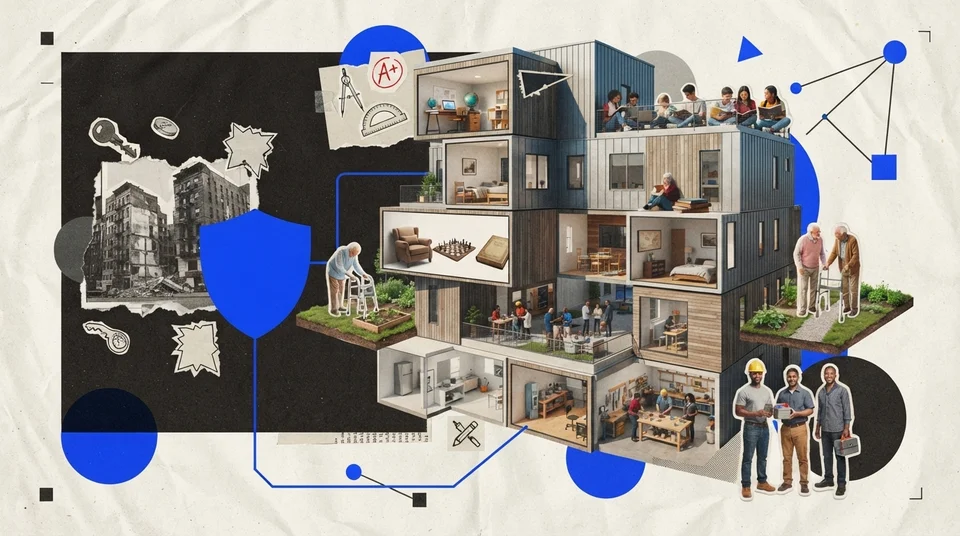
In short — The private market builds for those who can pay for new construction; everyone else waits. Three groups pay the price more than anyone: students, whose largest recent Quebec project — 155 units in Rimouski — was delivered modular; seniors, more than 840 of whom were displaced by RPA closures in 2025; and regional workers, for whom Baie-Comeau is building 72 units designed to replace the work camps. Three different problems, one common denominator: the need for standardized buildings, delivered fast — exactly where the factory excels.
The housing market has its darlings: the buyer of a new condo, the tenant of the "luxury" two-bedroom. And it has its blind spots — entire groups whose housing does not pay enough to interest a conventional developer. Let's tour the people the system misses, and what factory construction concretely changes for them.
Students: the proof of concept is called Rimouski
Every September, the same news story: students on couches, lineups at apartment viewings. The most convincing answer to date came from a non-profit, UTILE, and a factory: 155 student housing units — 126 studios and 29 two-bedroom units, for about 180 students — delivered in Rimouski for July 1, 2025, in time for the school year. A project of about $30 million, rents controlled for at least 35 years, and a roughly ten-month timeline made possible by modules manufactured in the factory while the site was being prepared. "We estimate we save at least half the construction time," said UTILE's executive director, Laurent Levesque — the estimate comes from the developer, but the calendar is public. The full case study is in our piece on modular student housing in Rimouski.
The model is spreading: 91 affordable student units are under construction near UQO in Gatineau (about $36.6 million), and UTILE is working on a pipeline to house 1,500 more students. Why is student housing modular's ideal proving ground? Small, identical units in large numbers, with a non-negotiable delivery date — the school year does not wait for the snow to clear. Our report on modular student housing digs into the question.
Seniors: when the residence closes, you have to rebuild fast
The quiet tragedy of Quebec housing is playing out among seniors: more than 840 residents displaced by RPA (private seniors' residence) closures in 2025 according to the AQRP — an improvement of about 40% over 2024, but still nearly one closure per week, and some 740 residences closed in eight years. The hardest-hit zone: the CIUSSS de la Mauricie-et-du-Centre-du-Québec, with 11 closures and 188 residents displaced in one year. The full regional context is in our Mauricie overview.
In response, a model is emerging: the standardized seniors' building, repeated from town to town. Mission Unitaînés builds 100-unit buildings on a single template — in Shawinigan: 74 one-bedroom units, 15 studios, 11 two-bedrooms over six storeys, ready in spring 2026; a twin in Trois-Rivières; another in Salaberry-de-Valleyfield for spring 2027. Standardization is already half the logic of prefab — the logical next step, manufacturing these templates in a factory to deliver them even faster, is exactly the scenario we explore in our piece on modular seniors' residences and RPAs.
Workers: housing the regional economy
Third blind spot: workers in the resource regions, whom employers house for lack of a market — sometimes in camps worthy of the 1970s. Baie-Comeau decided to do things differently: the Société d'expansion de Baie-Comeau is building 72 units for temporary workers, explicitly designed to replace the camps, with delivery targeted for 2027. On a Côte-Nord where the housing shortage is holding back entire industrial projects, it is a change of philosophy: house the economy, not just the company.
The phenomenon extends far beyond the Côte-Nord — tourism-worker boarding houses in Charlevoix, a land trust in the Laurentides, houses bought by mining companies in Abitibi — and our report on workforce housing in the regions covers it all. The common thread with students and seniors jumps out: mid-sized buildings, repetitive units, an urgent need, a local market unable to deliver. That is the very definition of a successful modular project — and it is why so many of these projects are born in regions like the Bas-Saint-Laurent.
These three groups cannot afford to wait out three years of job-site work. The factory does not need them to. Does your organization house one of them? We can show you where to start.

8Module
Modular multi-residential buildings (6 to 24+ units) factory-built in Quebec.
Visit websiteCommercial partnership — we receive compensation. Disclosure
Frequently asked questions
Why is student housing such a good fit for modular?
What happens to seniors when an RPA closes?
Is worker housing the return of the work camps?
Sources
- 155 logements abordables pour les étudiants seront construits rapidement à Rimouski — UTILE
- Logement étudiant : le chantier UTILE à Rimouski — Radio-Canada
- Fermetures de RPA en 2025 — AQRP
- Fermetures de RPA au Québec : « On a les deux pieds dans la crise » — La Presse
- Pelletée de terre : logements Unitaînés à Shawinigan — Radio-Canada
- Une première à Baie-Comeau : 72 logements pour les travailleurs temporaires — Le Nord-Côtier
- Construction de 91 logements abordables pour les étudiants de l'UQO — Gouvernement du Québec




Comments
A question or comment on this article? The comments section will be enabled soon.