Fundamentals · 10 min
Modular Construction and the Quebec Construction Code (RBQ)
In short — In Quebec, modular construction on a permanent foundation follows the same Quebec Construction Code as a home built on-site. The builder must hold a valid licence from the Régie du bâtiment du Québec (RBQ, Quebec's building authority), the project requires a municipal permit, and a new home is generally covered by a residential construction warranty plan. In short: this is not an "off-standard" product.
Many buyers hesitate when considering modular because they are not sure it is as well regulated as a traditional home. Good news: it is. Here, in plain language, is who governs what, what you need to verify, and what the warranties cover. (This article is informational and does not replace legal advice or the official information provided by the RBQ.)
Who does what: RBQ, municipality, Code
Three players regulate your project, each with a distinct role.
- The Régie du bâtiment du Québec (RBQ, Quebec's building authority) administers the Quebec Construction Code and issues contractor licences. It sets the technical rules for construction and qualifies the companies authorized to build.
- The municipality issues the building permit, enforces zoning, and carries out its own on-site inspections. No home — modular or otherwise — may be legally built without a permit.
- The Quebec Construction Code is the body of technical standards (structure, insulation, fire safety, electrical, plumbing) that every building must meet.
The key point: these three frameworks apply in the same way to modular construction on a foundation as to traditional construction. The method changes; the regulations do not. This is covered in What is modular construction?.
The Construction Code: same standards, different manufacturing
Modular construction must meet the same structural, insulation, fire safety, and ventilation requirements as a conventional home. The difference lies not in the standards, but in the place and time at which they are applied:
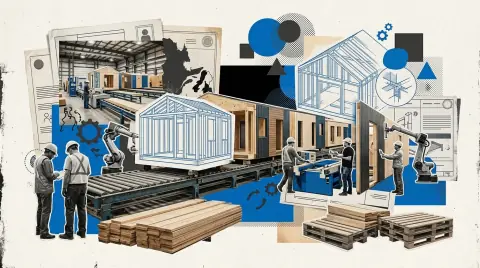
- In the factory, compliance with the Code is verified at every stage of the production line, before the module is closed up. Elements that are normally hidden (framing, insulation, plumbing inside walls) can be inspected while they are still accessible.
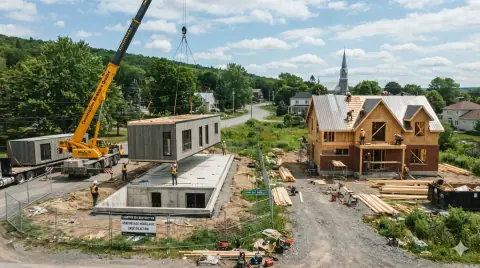
- On the site, the municipality inspects the foundation, the assembly, the utility connections, and the module joints.
This double layer of inspection is one of the quality arguments for modular construction: problems are caught when they are easiest to fix.
The RBQ licence: the first thing to verify
In Quebec, building (or having something built) generally requires working with a contractor who holds a valid RBQ licence in the right category. That is your first protection.
Before signing anything:
- Ask for the licence number of the builder.
- Verify it in the RBQ's public registry (validity, category, restrictions).
- Confirm the subcontracting: who is handling the foundation, transport, assembly, and on-site finishing — and does each hold the required licences.
This verification is also a central criterion for choosing your modular builder.
"The RBQ licence is not a formality: it is the line that separates a protected project from a project at risk."
Municipal permit and zoning
The building permit is obtained from the municipality, as with any home. Points to validate early:
- Does the zoning allow your type of building (single-family, multiplex, ADU)?
- Are setbacks, heights, and siting requirements met?
- Does the municipality have particular requirements regarding foundations or utility connections?
- Does the site access allow for module delivery and crane manoeuvring?
Permit timelines are part of the overall schedule; they are factored into the comparison in modular home vs. traditional construction.
Warranties: what protects you after delivery
A new home in Quebec is generally covered by a residential construction warranty plan, which protects the buyer against certain defects and problems over defined periods (deposit, completion, hidden defects, major structural defects). This plan applies to eligible new construction — modular included — when the builder is enrolled.
Points to validate:
- Is the builder enrolled in the applicable warranty plan?
- Does the contract specify the covered elements and timelines?
- Who assumes the warranty for work performed on-site (foundation, assembly, connections)?
Confirm these details in writing. The warranty is a major safety net — but only if the project is properly enrolled in it.
Modular ≠ mobile home: the regulatory distinction
This is the most costly confusion. A mobile home rests on a chassis and is not attached to a permanent foundation: it falls under a different regulatory and financial framework. Modular construction on a permanent foundation is, in the eyes of the law, conventional construction — hence the access to conventional mortgages and warranties. This distinction is decisive for financing, as our guide modular home mortgage and financing explains.
In summary
- On a permanent foundation, modular construction follows the same Quebec Construction Code as traditional construction.
- The builder must hold a valid RBQ licence — verify it in the public registry.
- A municipal permit is mandatory; zoning and site access must be validated early.
- An eligible new home is generally covered by a warranty plan.
- Modular ≠ mobile home: the permanent foundation changes everything, both legally and financially.
Sources: Régie du bâtiment du Québec (Construction Code, licences), Garantie de construction résidentielle (GCR), APCHQ. Informational article written by Jeremy Soares; does not replace legal advice. Last updated: June 24, 2026.

8Module
Modular multi-residential buildings (6 to 24+ units) factory-built in Quebec.
Visit websiteCommercial partnership — we receive compensation. Disclosure
Frequently asked questions
Does a modular home have to comply with the Quebec Construction Code?
Does a modular home builder have to hold an RBQ licence?
Is a municipal permit required for a modular home?
Is a modular home covered by a warranty?
Sources
- Quebec Construction Code and Contractor Licences — Régie du bâtiment du Québec (RBQ)
- Garantie de construction résidentielle (GCR) — GCR
- Residential Construction Data — APCHQ



Comments
A question or comment on this article? The comments section will be enabled soon.