Commercial · 9 min
Temporary Buildings and Modular Site Offices in Quebec
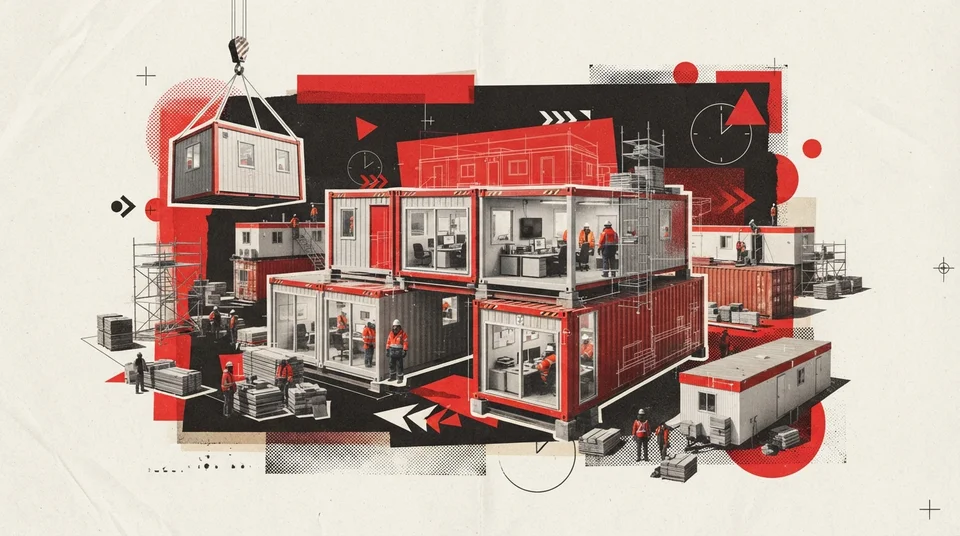
In short — A temporary modular building is a factory-built structure, delivered ready for use, installed for a limited period, then removed or redeployed elsewhere. In Quebec, it is used primarily as a site office, overflow space, temporary classroom, or temporary clinic. Its strengths: deployment in a matter of days, available for rent (without tying up capital), and reuse from one site to the next.
Not every modular project is permanent. A significant — and often overlooked — segment of the market involves temporary buildings: installed to meet a short-term need, then taken away. This is one area where modular has virtually no competition.
What they are used for
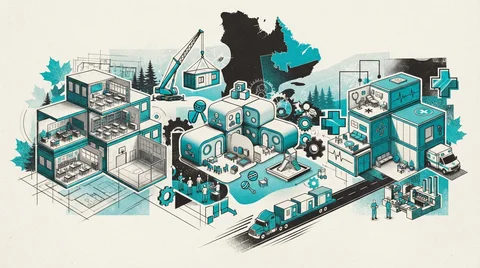
The most common applications in Quebec:
- Site offices — the classic case: housing the project management team, plans, and meetings alongside a large construction site.
- Business overflow space — temporary administrative space during an expansion or renovation.
- Temporary modular classrooms — absorbing school overcrowding while a permanent expansion is built.
- Temporary clinics and health services — community health points, vaccination, intake.
- Event or seasonal buildings — welcome areas, ticketing, cloakrooms.
The common thread: a need that is time-limited or mobile, where building in place would make no sense.
Rent or buy?
This is the first decision, and it is fundamentally a financial one.
| Option | Best for | Logic |
|---|---|---|
| Rental | Short or uncertain need (site, stopgap) | No capital tied up; return the unit when done |
| Purchase | Recurring or extended need | Amortized; reused across multiple projects |
| Used purchase | Tight budget, standard requirement | Active market for reconditioned units |
Many construction companies own their site offices and move them from project to project; others rent as needed. For a one-off need lasting a few months, rental is almost always the right answer.
Worth remembering — Temporary needs should be evaluated on cost of use, not cost of construction. The question is not "how much does it cost to build" but "how much does it cost for the duration of the need."
Timelines: the decisive argument
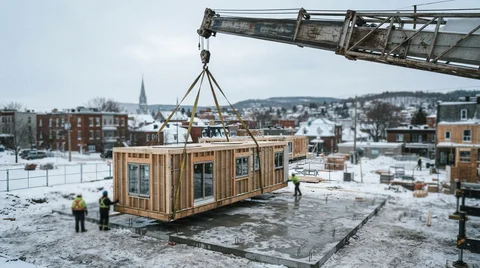
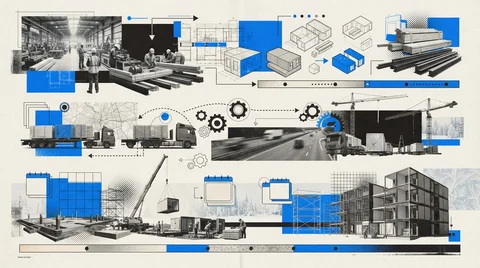
This is where temporary modular leaves alternatives far behind. Units are already built (or in the supplier's inventory); installation comes down to preparing a base, delivering, setting down, and connecting. Where a purpose-built space would take months, a temporary unit can be operational within days. And when it comes time to dismantle, the site is freed just as quickly.
This advantage extends to removal and redeployment — something permanent structures simply cannot offer. The same unit can serve three different sites over three years.
Costs: what goes into the bill
Beyond the unit price (or monthly rental), budget for:
- Round-trip transport to the site.
- Base preparation and levelling (blocks, slab, or piles depending on the terrain and duration).
- Temporary hookups (electricity, sometimes water/sewer or tanks).
- Crane or placement truck for larger or stacked units.
- Municipal fees: temporary use generally requires authorization from the municipality, with conditions on duration.
For permanent commercial buildings, see our article on commercial modular buildings and the commercial and multifamily pillar.
Regulations: they apply even for temporary use
A temporary building is still subject to the Quebec Construction Code on safety matters (structure, fire safety, egress, accessibility depending on use). Factory production is governed by CSA A277 certification. The municipality controls the duration and conditions of temporary use — a point to confirm early, since authorization timelines vary.
On-site work (base, hookups, anchoring for wind loads) must comply with applicable rules. For the full regulatory framework, see modular construction and the RBQ.
Wood or steel?
For units that get relocated and stacked, durability in transit and handling matters. Steel dominates for heavily used, stackable units; wood remains relevant for lighter, more economical options. The choice depends on the intended use and how many deployment cycles are planned — see wood vs. steel structure.
Sources: Régie du bâtiment du Québec (Construction Code), CSA Group (standard A277). Guide written by Jeremy Soares. Last updated: June 25, 2026. Costs and timelines cited are indicative ranges to be validated before any commitment.

8Module
Modular multi-residential buildings (6 to 24+ units) factory-built in Quebec.
Visit websiteCommercial partnership — we receive compensation. Disclosure
Frequently asked questions
Can you rent a modular site office in Quebec?
Does a temporary building require a permit?
How quickly can a temporary building be operational?
Can the same unit be reused across multiple projects?
Sources
- Code de construction du Québec — Régie du bâtiment du Québec (RBQ)
- Norme A277 — certification d'usine — Association canadienne de normalisation (CSA)


Comments
A question or comment on this article? The comments section will be enabled soon.