Non-profit · 7 min
Housing and Modular Construction in the Bas-Saint-Laurent: The 2026 Picture
In short — The Bas-Saint-Laurent is living through an affordability crisis that is now hitting its mid-sized cities: rents jumped roughly 14% in one year in Rimouski and more than 10% in Matane. The region landed no project in the SHQ's first call for highly prefabricated housing in 2025 — yet it is already home to Quebec's best modular case study: UTILE's 155 student housing units in Rimouski, delivered in about ten months. The proof happened right here.
The housing situation in the region
Long seen as a quiet market, the Bas-Saint-Laurent has caught up — in the wrong direction — with the pressures of the big centres. According to figures reported by Radio-Canada in early 2026, the average rent climbed roughly 14% in one year in Rimouski and 10.4% in Matane. In Rivière-du-Loup, the average rent went from about $832 to $862 per month.
These increases fit a provincial trend: the vacancy rate in Quebec's urban centres rose back to 2.9% in October 2025 according to CMHC, but the easing comes almost entirely from expensive new units. The affordable segment remains in shortage. That is exactly what the region's community groups are denouncing: in February 2026, the Comité logement Bas-Saint-Laurent and FRAPRU held assemblies in Rivière-du-Loup and Matane to sound the alarm on deteriorating housing conditions.
For towns of 5,000 to 25,000 residents — think Amqui, Mont-Joli, La Pocatière or Témiscouata-sur-le-Lac — the problem is compounded by a structural challenge: conventional developers rarely travel there for projects of 20 or 30 units. We break down that mechanism in our feature on the housing crisis and modular construction.
Recent projects and announcements
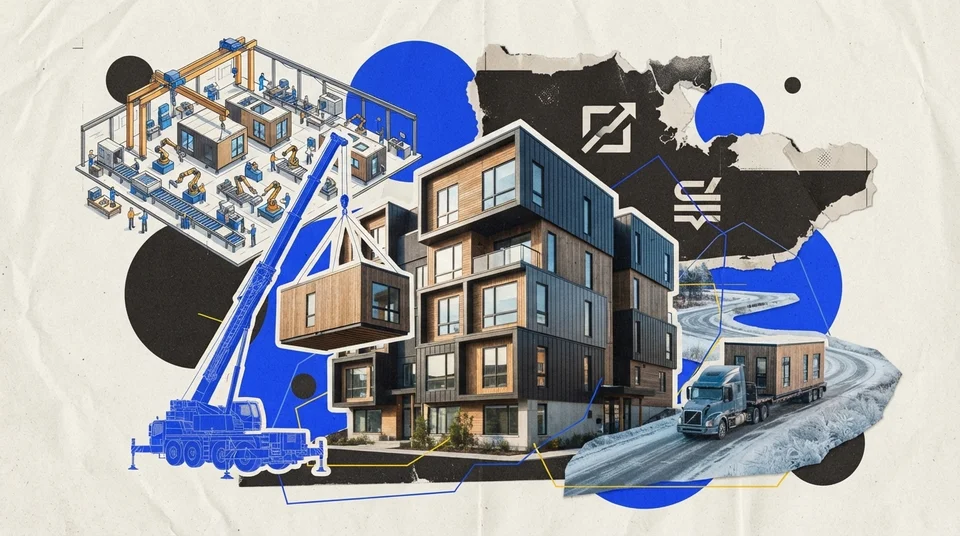
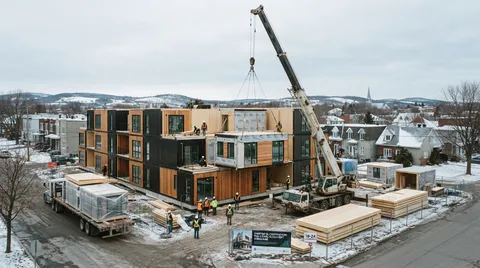
The project that dominates the regional picture is also Quebec's best-documented modular case study. In Rimouski, the non-profit UTILE delivered 155 student housing units (126 studios and 29 two-bedroom units, for about 180 students) on rue Alcide-C.-Horth, near UQAR. The modules were built by Industries Bonneville at its Belœil plant, and the first tenants moved in on July 1, 2025 — roughly ten months after the project was announced. Total cost: about $30 million, with rents capped for a minimum of 35 years. "We estimate we saved at least half the construction time," UTILE executive director Laurent Levesque told Radio-Canada. A second Rimouski project is in planning. We devoted a full case study to the UTILE project in Rimouski.
Still in Rimouski, the conversion of the Grand Séminaire is expected to add some sixty affordable community housing units on the adjacent grounds, as reported by FLO 96.5 in 2026. And the regional pipeline is delivering for other groups too: on June 19, 2026, UQAR opened a residence of 25 four-bedroom student units (an $11.7-million project first funded through the PHAQ), while Matane saw a 32-unit adapted-housing complex led by Logement HAN delivered in 2025 — two files we detail in our article on the housing projects delivering, from Rimouski to Matane.
An honest observation is also in order: in the SHQ's first call for highly prefabricated housing projects, whose 11 winners (336 units) were announced on August 22, 2025, no project from the Bas-Saint-Laurent was selected. Neighbouring Gaspésie landed three. Nothing stops the region from positioning itself for what comes next: a second call for 225 units was launched in September 2025, and the total selected had reached 566 prefabricated units by mid-2026 according to SHQ communications.
What modular can change here
The Bas-Saint-Laurent does not need to be convinced by foreign studies: the demonstration happened on its own turf. The UTILE build confirmed at regional scale what independent data measures elsewhere — McKinsey puts the reduction in project timelines at 20 to 50%, and a field study funded by the U.S. Department of Energy measured deliveries 25 to 30% faster across more than 50 multi-family buildings.
For towns like Amqui, Mont-Joli or Témiscouata-sur-le-Lac, the argument is twofold. First, speed: factory fabrication moves ahead while the site is being prepared, and a building goes up in a few days once the modules are delivered (see our feature on the modular multiplex). Second, access: the standardized 24- and 36-unit buildings of the SHQ initiative are designed precisely for municipalities the big developers ignore. Municipalities that want to line up a site, zoning and a financing package should start with our guide for municipalities.
Let's stay clear-eyed: modular does not guarantee an automatic discount. Direct savings range from 0 to 20% depending on market and scale. The reliable gain is time — and in a market where rents are rising 10 to 14% per year, every month of construction avoided counts.
The programs that apply
- PHAQ (Programme d'habitation abordable Québec): the SHQ's flagship program, open to non-profits, co-operatives, housing offices and private developers. The 2026-2027 Quebec budget funds a new round of 1,000 affordable units — the first since 2023.
- SHQ initiative for highly prefabricated multi-unit housing: 500 units in the first call, 225 in the second, funded by the $1.8-billion Canada-Quebec agreement (FACL). Watch for the next calls.
- CMHC — mortgage loan insurance extended to modular (May 2026): after a pilot of more than 800 units, CMHC now insures modular multi-unit housing across all its products, including APH Select.
- Maisons Canada: the federal agency with $13 billion explicitly prioritizes prefabricated, modular and mass-timber construction.
For the detailed financing structure of a non-profit or co-operative project, see our guide to funding affordable modular housing.
Sources: Radio-Canada, Journal Le Soir, Mon Témiscouata, UTILE, Portail Constructo, CMHC, Gouvernement du Québec (SHQ). Article written by Jeremy Soares. Last updated: July 3, 2026.

8Module
Modular multi-residential buildings (6 to 24+ units) factory-built in Quebec.
Visit websiteCommercial partnership — we receive compensation. Disclosure
Frequently asked questions
Why did the Bas-Saint-Laurent get no SHQ prefabricated project in 2025?
Did the UTILE project in Rimouski really go faster than a traditional build?
Can a small town in the region host a 24-unit modular building?
Sources
- Crise du logement : des appartements de plus en plus coûteux au Bas-Saint-Laurent — Radio-Canada
- Des logements inabordables au Bas-Saint-Laurent — Journal Le Soir
- 155 logements abordables pour les étudiants seront construits rapidement à Rimouski — UTILE
- Construire autrement et plus rapidement : la voie du hautement préfabriqué est maintenant tracée — Gouvernement du Québec
- Crise du logement au Bas-Saint-Laurent : les groupes communautaires sonnent l'alarme — Mon Témiscouata
- Official opening of affordable housing units for students at the Université du Québec à Rimouski — Education News Canada
- Les gouvernements du Québec et du Canada appuient la construction de logements pour personnes handicapées à Matane — Canada Newswire (CNW)





Comments
A question or comment on this article? The comments section will be enabled soon.