Commercial · 9 min
Modular Schools, Daycares and Clinics in Quebec
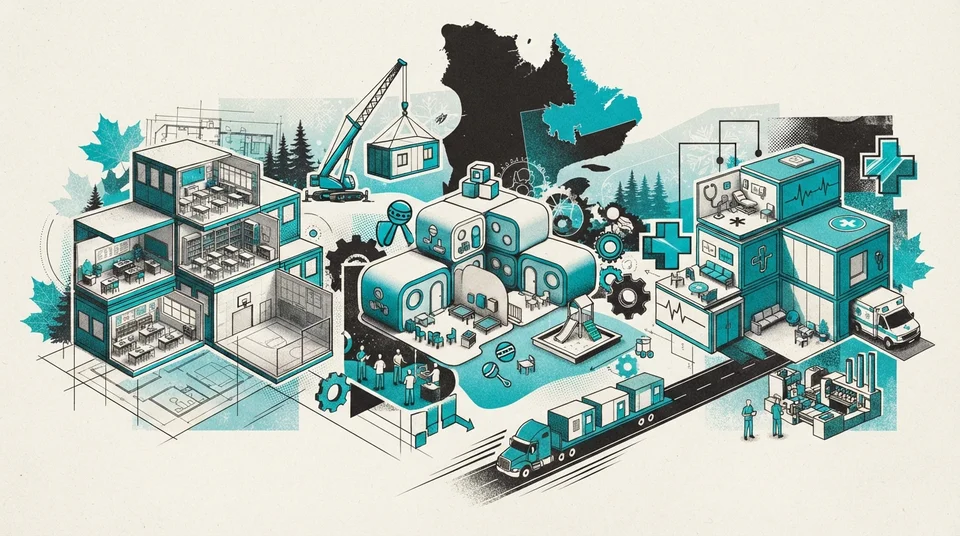
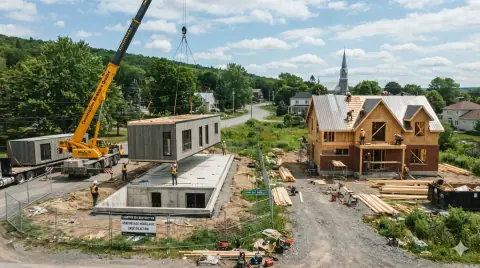
In short — Modular construction is increasingly used in Quebec for institutional buildings: school additions, classroom pavilions, CPE (centres de la petite enfance) and daycares, clinics. The reason is simple: these projects need space quickly, often without interrupting an active service — and that is precisely what modular makes possible.
When people think "modular," they picture a house. But one of the most promising applications in Quebec is institutional: public or community buildings where speed to occupancy and schedule predictability matter as much as cost. French-language content on this topic is scarce — a real opportunity for decision-makers to get a clear picture.
Why modular for institutional buildings
Three needs converge in these projects:
- Speed. An overcrowded school, a daycare waiting list, an overwhelmed clinic: the need is immediate. Factory production, running in parallel with site work, compresses the schedule.
- Service continuity. You are expanding a school during the school year, a clinic while it stays open. Modular reduces the duration and disruption of on-site construction.
- Repetition. Classrooms, daycare rooms: these are similar units, repeated — the ideal use case for the factory floor.
Worth remembering — In institutional settings, modular is sold on schedule and service continuity as much as on cost: opening spaces on time has real value in itself.
For the general logic behind commercial and collective buildings, see the commercial and multifamily pillar.
The most common uses
| Use | Why modular works |
|---|---|
| Pavilion / classrooms added to a school | Fast space without shutting the school down |
| CPE and daycares | Repetitive spaces, fast deployment, clear standards |
| Clinics and healthcare service points | Fast commissioning, possibility of relocation |
| Public offices and administrative spaces | Standardization, cost predictability |
| Transitional solutions | Before a permanent building — see temporary buildings |
The line between temporary and permanent matters: a school pavilion can be placed permanently on a foundation, or installed temporarily during a longer expansion.
Permanent or transitional?
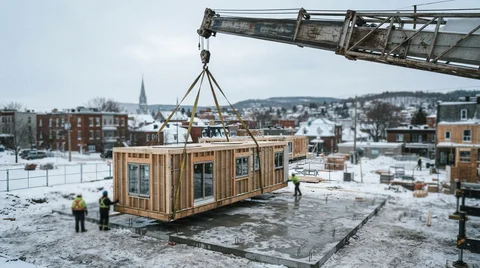
- Permanent — set on a foundation, integrated into the existing building, with a lifespan comparable to conventional construction. It is a full-scale addition, simply built differently.
- Transitional — installed to absorb a temporary surplus, then removed or redeployed. See the dedicated article on temporary buildings and site offices.
The choice depends on the actual need: a structural deficit in spaces calls for permanent; a temporary peak calls for transitional.
Regulations: demanding, and rightly so
Institutional buildings carry heightened requirements — fire safety, egress and evacuation, accessibility, air quality, and use-specific standards (childcare settings, schools, healthcare). All of this falls under the Quebec Construction Code and the applicable sectoral regulations; factory production is governed by CSA A277 certification.
In other words, modular waives none of the requirements. It changes the method of construction, not the level of compliance expected. For the regulatory framework, see modular construction and the RBQ, and for certifications and programs, certifications, associations and funding.
Costs and financing
Like any modular project, the total cost combines the building from the factory, the land/site, foundation, hookups, and transport. For institutional projects, financing often flows through public programs (school infrastructure, daycare spaces, healthcare), whose criteria and envelopes evolve — to be verified case by case with the relevant agencies. The key economic value remains the schedule: opening spaces sooner reduces indirect costs (rental of overflow space, student transportation, waiting lists).
Sources: Régie du bâtiment du Québec (Construction Code), CSA Group (standard A277), Gouvernement du Québec (infrastructure). Guide written by Jeremy Soares. Last updated: June 25, 2026. Programs, criteria and amounts must be validated with official agencies.

8Module
Modular multi-residential buildings (6 to 24+ units) factory-built in Quebec.
Visit websiteCommercial partnership — we receive compensation. Disclosure
Frequently asked questions
Does a modular school or daycare meet the same standards as a traditional building?
Why do school boards use modular classrooms?
Is a modular pavilion necessarily temporary?
Is modular less expensive for an institutional project?
Sources
- Code de construction du Québec — Régie du bâtiment du Québec (RBQ)
- Norme A277 — certification d'usine — Association canadienne de normalisation (CSA)
- Infrastructures scolaires et habitation — Gouvernement du Québec

Comments
A question or comment on this article? The comments section will be enabled soon.