Fundamentals · 8 min
Myths and Misconceptions About Modular Construction
In short — Modular construction carries a reputation that the facts no longer justify. "It's cheap," "it resells poorly," "it's a mobile home": these ideas have circulated for decades and reflect a reality that has changed. Here are five common myths, debunked one by one.
There is something ironic about the trajectory of modular construction in Quebec. On one side, developers and housing offices are turning to it en masse — notably to deliver housing in half the time of traditional construction. On the other, buyers still hesitate, convinced that the word "prefab" is synonymous with compromise.
Where does this gap come from? Partly from a confusion between products (a real modular home on a foundation has nothing in common with a 1970s mobile home), and partly from past experiences with builders who, indeed, delivered below standard. Those days are over — but the myths persist.
We take them on one by one.
Myth No. 1: "It's cheap — the quality is inferior"
The myth: A prefab home costs less, so the materials and finishes must necessarily be lower quality. It's for people who can't afford to build "for real."
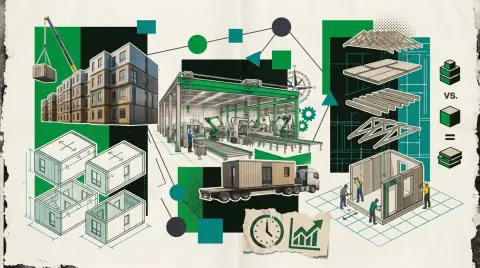
The reality: The lower cost (when it exists) is explained primarily by the efficiency of the process, not by low-grade materials. In a factory, wood offcuts are minimized, crews don't lose time to rain or cold, and the repetition of tasks reduces costly errors. This is industrial engineering applied to construction, not a reduction in standards.
Serious manufacturers use the same materials as on-site construction — often the same insulation standards, the same windows, the same mechanical systems. Some even offer high-end finishes that few traditional job sites can match in terms of execution precision.
The real cost differentiator is time — not materials. Fewer weeks on-site means less labour cost, less equipment rental, less supervision. To understand how these savings break down within a budget, see our modular home price guide for Quebec.
"In a factory, construction happens sheltered from wind, frost, and rain. Quality control is not better by chance — it is structural."
Myth No. 2: "A modular home is less structurally sound"
The myth: Assembled in sections, a modular home is inherently less solid than one built as a single unit on-site.
The reality: The opposite is often true. Modules are designed to be lifted by a crane and transported hundreds of kilometres — sometimes in winter, over rural roads. To withstand these stresses, the structures are reinforced beyond the minimum requirements of the Quebec Construction Code.
Concretely: the walls and floors of a module must absorb lifting and vibration forces that on-site construction simply does not anticipate. That structural reinforcement becomes an advantage once the home is in place.
Moreover, factory construction allows step-by-step inspections — framing, insulation, plumbing, electrical — before the walls are closed. On a traditional job site, some of these stages are difficult to inspect after the fact. Details on inspection and certification standards can be found in our article on modular construction and the Quebec Construction Code (RBQ).
Myth No. 3: "It resells poorly"
The myth: A prefab home loses value faster, banks are reluctant to lend, and prospective buyers will walk away at resale.
The reality: This idea comes from an era when "prefab" often referred to mobile homes or temporary structures. A modular home on a permanent foundation, built to the Quebec Code, is a full-fledged property — legally and for tax purposes.
What influences resale value are the same factors as for any home: location, maintenance, finish quality, and local market conditions. In regions where modular construction is well established and known to appraisers, resale values are comparable to traditional homes of equivalent size.
That said, two precautions apply. First, in some rural or semi-urban markets, appraisers have less experience with this building type — it can be worth documenting construction quality and certifications at the time of sale. Second, a modular home that is not on a permanent foundation (e.g., chassis, blocks) is treated differently — and there, buyer and lender wariness is justified. Our article on lifespan and resale value goes deeper on this distinction.
Myth No. 4: "They are ugly — they all look the same"
The myth: A modular home is a uniform rectangular box. No personality, no distinctive style.
The reality: This image corresponds to the production of the 1980s–1990s, when the product ranges were limited and exterior finishes offered little variety. The market has evolved.
Today, manufacturers offer dozens of modifiable base plans, and module combinations allow L-shaped, U-shaped, or staggered-volume configurations. Exterior cladding — board-and-batten, stone, brick, composite — is the same as for on-site construction. Notable architectural projects use prefabricated modules precisely because they allow rigorous repetition of complex forms that traditional job sites cannot reproduce identically.
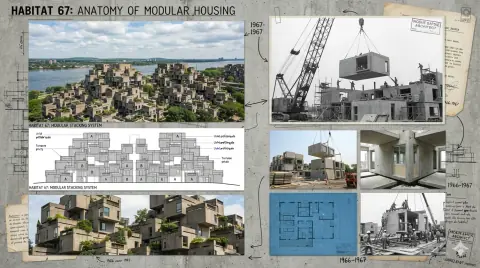
The most famous example remains Habitat 67, in Montreal — an eloquent demonstration of what modular prefabrication can produce architecturally. (See our Habitat 67 feature.)
The real stylistic constraint of modular construction is budget — not technology. A tight budget will lead to basic finish choices, whether you build modular or traditionally.
Myth No. 5: "It's a mobile home"
The myth: "Prefab" and "mobile home" are the same thing. It's a trailer on blocks, it won't last, and banks won't finance it.
The reality: These are two fundamentally different products, which the law treats in distinct ways.
| Criterion | Modular home | Mobile home |
|---|---|---|
| Foundation | Permanent (concrete, piles) | Steel chassis or blocks |
| Legal status | Real property | Personal property (in general) |
| Applicable code | Quebec Construction Code | CSA Z240 standards |
| Financing | Standard mortgage possible | Personal or specialized financing |
| Municipal permit | Required (like any home) | Depending on zoning and park rules |
| Can be moved | No (fixed on foundation) | Yes (that's the point) |
The confusion comes from history: in the 1960s–1970s, "prefab" did in fact encompass mobile homes, site offices, and the first manufactured homes. The industry evolved, the terms became more precise, but the prejudice survived. For the full distinctions between these categories, see our article Modular, manufactured, prefab: the differences.
What the myths conceal: the real trade-offs
Debunking myths does not mean claiming that modular construction is perfect. There are real trade-offs that every buyer should know.
Customization has practical limits. Once manufacturing is underway, modifications are costly or impossible. The decision to customize must be made before the order is placed, not after.
Transport imposes size constraints. Modules must travel on public roads, which limits their width and height. Some architecturally complex configurations are harder to achieve than with on-site construction.
Delivery logistics are more demanding. Assembly day requires a clear site access, a crane, and precise coordination. On difficult-to-access sites, this can be a challenge.
These constraints are real — but they are different from the myths. They deserve to be evaluated seriously, not confused with quality defects.
Summary table: myth vs. reality
| Misconception | Verdict | Nuance |
|---|---|---|
| "It's cheap / low-end" | False | Lower cost comes from efficiency, not quality |
| "Less structurally sound" | False | Often reinforced beyond Code requirements for transport |
| "It resells poorly" | Partially true in the past | On a permanent foundation, value comparable to the local market |
| "They're ugly, all look the same" | Outdated | Wide variety of plans and finishes available |
| "It's a mobile home" | False | Two distinct products, different laws and financing |
Sources: Régie du bâtiment du Québec (Quebec Construction Code), CMHC — Canada Mortgage and Housing Corporation, APCHQ. Article written by Jeremy Soares. Last updated: June 24, 2026.

8Module
Modular multi-residential buildings (6 to 24+ units) factory-built in Quebec.
Visit websiteCommercial partnership — we receive compensation. Disclosure
Frequently asked questions
Does a modular home comply with the Quebec Construction Code?
Is it true that a bank will refuse to finance a modular home?
Does a modular home last as long as a traditional home?
Can a modular home really be customized?
Is modular construction really faster?
Sources
- Quebec Construction Code — Régie du bâtiment du Québec (RBQ)
- Housing Market Outlook — CMHC — Canada Mortgage and Housing Corporation
- Residential Housing Start Data — APCHQ


Comments
A question or comment on this article? The comments section will be enabled soon.