
Non-profit · 12 min
Modular Construction and Quebec's Housing Crisis
In short — Modular construction will not solve Quebec's housing crisis on its own, but it addresses its best-documented bottleneck: time. Independent studies measure projects delivered 20 to 50% faster than traditional construction, and both orders of government — the SHQ's project call for 500 highly prefabricated units, the Maisons Canada agency, and CMHC's mortgage insurance expanded to cover modular in May 2026 — are now explicitly betting on this sector to deliver affordable housing.
For non-profit organizations, housing offices, municipalities, and developers, the question is no longer "Is modular construction serious?" but "For which projects, under what conditions, and with what financing?" This article takes stock, with sourced figures — including what modular does not guarantee.
A crisis changing shape: the shortage shifts toward affordable
On the surface, Quebec's rental market is easing. According to the CMHC Rental Market Report 2025 (October 2025 data), the vacancy rate in urban centres of 10,000 residents and more in Quebec has climbed to 2.9%, up from 1.8% one year earlier. The Montréal census metropolitan area shows the same 2.9%, the Québec City metro area 2.4% (after a historic low of 0.9%), and Gatineau approximately 3.8%, the highest rate in the province.
But this easing is deceptive — and that is the central point for anyone working in affordable housing. In Montréal, the most affordable rent quartile shows a vacancy rate of only 1.3%, versus 4.9% for the most expensive quartile, according to CMHC data reported by Radio-Canada. In the Québec City region, the affordable segment hovers around 1% (Radio-Canada). In other words: new, expensive units are opening up; affordable ones remain almost impossible to find.
On the rent side, the pressure is not letting up. The average rent for a two-bedroom unit in the Greater Montréal Area reached $1,346 per month, up 7.2% between October 2024 and October 2025, following a +6.3% increase the year before (CMHC via Le Devoir). The Québec City region recorded a record increase of +6.4%. The Tribunal administratif du logement (TAL, Quebec's rental tribunal) had proposed a basic adjustment rate of 5.9% for 2025, one of the steepest increases in over thirty years; for 2026, early indications point to a basic rate of at least 3.1% (Le Devoir). CMHC's finding: in Greater Montréal, rent increases have outpaced income growth. And on social housing (HLM) waiting lists in Quebec, there are still more than 30,000 households according to figures cited by FRAPRU — a figure to confirm directly with the Société d'habitation du Québec (SHQ, Quebec's housing corporation), but one that signals the scale of the backlog.
The scale of the deficit: build far more, far faster
The official targets are staggering. In its 2023 update, CMHC estimated that approximately 860,000 additional housing units would be needed in Quebec by 2030 to restore affordability — a dated figure whose provincial breakdown needs to be revalidated against the revised 2025 framework, but which gives the order of magnitude (CMHC, 2023 report). The Government of Quebec, for its part, is targeting 560,000 new homes by 2034 under its Quebec Housing Strategy of August 2024.
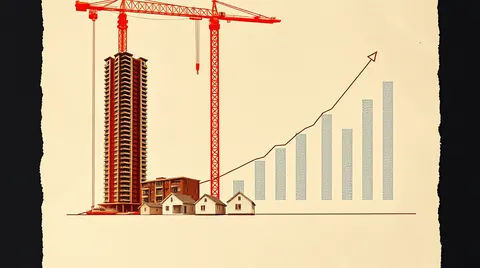
Yet even a record-breaking year falls short. Quebec recorded approximately 48,700 housing starts in 2024 (+26% vs. 2023, with 80% in rental apartments), according to CMHC data relayed by APCHQ. APCHQ was forecasting 53,000 starts in 2025 and 56,750 in 2026, and the first half of 2025 was running +35% versus the same period of 2024. Despite this, the association estimates that the pace would need to roughly quadruple to close the deficit by 2030.
The problem is therefore not only financial: it is a production capacity problem. A limited labour force, short construction seasons, sequential job sites — traditional construction is hitting a ceiling. That is precisely the barrier that factory prefabrication is trying to break, by turning construction into an industrial process that runs year-round, sheltered from the elements.
What modular actually delivers: speed, first
On speed, the independent evidence converges — and that is the sector's strongest argument.
| Evidence | Measured result | Source | Year |
|---|---|---|---|
| Global sector analysis | Projects delivered 20 to 50% faster than traditional construction | McKinsey & Company | 2019 (reference still cited globally) |
| Field study of 50+ multifamily buildings (funded by the U.S. DOE) | Buildings completed 25 to 30% faster on average than site-built comparables | Modular Building Institute | 2024 |
| Canadian pilot verified by CMHC (605 Studio West, Calgary) | 84 affordable units built and occupied in under one year, versus nearly two years for a comparable conventional project in the same neighbourhood | CMHC | 2026 |
| Documented Quebec case (UTILE, Rimouski) | 155 student housing units delivered in approximately 10 months, from announcement to first tenants | Portail Constructo | 2025 |
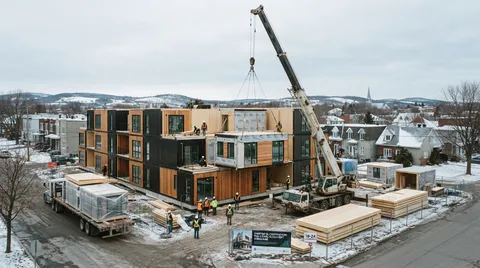
The mechanism is straightforward: module manufacturing in the factory happens in parallel with foundation and infrastructure work on site. The job site becomes an assembly operation. CMHC also highlights the quality gains: less weather exposure, less material waste, kitchens and bathrooms installed in the factory (CMHC). We detail the Rimouski case in our case study on the 155 modular student housing units, and the typical project flow in our article on modular project timelines and scheduling.
For affordable housing, this speed is not a bookkeeping luxury. Every month saved is one less month of interim financing costs, reduced exposure to construction-cost inflation, and — most importantly — families housed sooner.
And costs? A real gain, but contextual — let's be honest
This is where the industry narrative often goes off the rails, and where honest treatment is necessary. McKinsey puts the potential savings at up to 20%, but only for operators who optimize the process at scale — it is not automatic. Independent analyses (Urban Institute, NIBS/WSP) add the essential nuance: direct savings of around 10 to 20% in labour-expensive markets, but cost parity, or even a slight premium, elsewhere. In those cases, the value of modular comes primarily from schedule compression and predictability — not from the unit price.
Two other financial realities to know before proceeding:
- Cash flow is different. Modular requires more equity, earlier in the project: the factory manufactures (and invoices) before the job site advances, whereas traditional financing disburses in line with site progress. Analyses cited by the Modular Building Institute document this gap; exact amounts vary by project.
- Published per-unit costs are not all comparable. The City of Montréal's transitional modular units came in at $157,000 per unit (La Presse) — but these are small transitional units, not a 6-to-24-unit family rental building. Never generalize a per-unit cost from one project type to another.
This realism does not weaken the case for modular: it makes it credible. We take apart the other common misconceptions in our article on modular construction myths.
Governments are on board: the sector is now institutionalized
The strongest signal of 2024–2026 is that prefabrication has moved from experiment to public policy, at both orders of government.
In Quebec. The Canada-Quebec agreement on the Fonds pour accélérer la construction de logements (FACL, Housing Accelerator Fund) — $900 million federal + $900 million from Quebec, totalling $1.8 billion for a target of 8,000 social and affordable housing units (Québec.ca) — funds, in particular, the SHQ's project call for 500 highly prefabricated housing units: a qualification call in August 2024, a project call in January 2025, and first deliveries expected in 2026 (Québec.ca). This is the first Quebec public program dedicated to highly prefabricated multi-unit housing.
At the federal level. The Maisons Canada (Build Canada Homes) agency, launched September 14, 2025 with an initial envelope of $13 billion, explicitly prioritizes prefabricated, modular, and mass-timber construction; its first initiative targets 4,000 prefabricated homes across six sites, one of them in Longueuil (Office of the Prime Minister of Canada).
On the financing side, the barrier fell in May 2026. After a pilot project that financed more than 800 modular rental units in five provinces, CMHC extended its multi-unit mortgage loan insurance to modular construction across all its products, including APH Select, and launched "Prefab Plus" for buyers (5% down payment, progressive drawdowns). The classic objection — "lenders and insurers won't follow modular" — no longer holds in Canada.
For program-by-program detail (who is eligible, for which type of project, what to verify before submitting), see our guide to financing an affordable modular housing project.
What this means for non-profits, municipalities, and developers
For non-profit organizations and co-operatives, modular addresses the number-one problem in community housing projects: the years that pass between securing financing and handing over keys, during which costs drift and needs worsen. The UTILE case in Rimouski — a non-profit, 155 units, approximately 10 months — shows that the model works at an institutional scale. Our guide on modular affordable and community housing covers the process step by step.
For municipalities, modular offers a rapid response to targeted needs: workforce housing, homelessness exits, gentle densification. Montréal's transitional units are one example — with a useful caveat: that project experienced delays related to site preparation and permits (La Presse). Modular compresses construction time; it does not immunize against permit, zoning, and site-preparation delays. That is, in fact, where municipalities have the most leverage.
For developers, the equation is now primarily financial: compressed schedule, earlier rental income, accessible CMHC mortgage insurance — versus an earlier equity requirement and the need to lock in design early. Our piece on the modular multiplex details the process for 6-to-24-unit buildings.
And on quality, the framework is already in place: in Quebec, no factory-built building may be sold, leased, or transferred without CAN/CSA-A277 certification from the Régie du bâtiment du Québec (RBQ, Quebec's building authority), attesting compliance with the applicable codes at the installation site (RBQ). The field study funded by the U.S. DOE measured equal or superior code compliance and energy performance compared to site-built comparables.
Limitations to keep in mind
For modular to deliver on its promises against the housing crisis, three conditions recur in every documented case:
- The site must keep pace with the factory. Permits, zoning, utility connections: if the land is not ready, manufacturing speed is meaningless. The delays on Montréal's transitional project illustrate this.
- Financing must match the industrial calendar. Progressive drawdowns, equity available early: that is precisely what CMHC's new products are beginning to address.
- Cost must be assessed as total project cost, including the time saved — not as a per-sq.-ft. box price. In some Quebec markets, modular will cost as much as traditional; it will simply deliver months sooner, with greater certainty.
Quebec's housing crisis is a problem of volume, price, and time. On time, modular's case is proven. On volume, public programs are building industrial capacity. On price, the honest answer is: it depends on the market — and saying so clearly is what builds projects that keep their promises.
Sources: CMHC — Canada Mortgage and Housing Corporation (Rental Market Report 2025; housing shortages 2023; news release May 2026), Gouvernement du Québec (Quebec Housing Strategy; SHQ project calls), Office of the Prime Minister of Canada (Maisons Canada), McKinsey & Company (2019), Modular Building Institute / U.S. DOE (2024), Urban Institute, NIBS/WSP, APCHQ, FRAPRU, RBQ, Le Devoir, Radio-Canada, La Presse. Article written by Jeremy Soares. Last updated: July 1, 2026.

8Module
Modular multi-residential buildings (6 to 24+ units) factory-built in Quebec.
Visit websiteCommercial partnership — we receive compensation. Disclosure
Frequently asked questions
Is modular construction really faster, or is that just marketing?
Does modular cost less than traditional construction?
Is modular housing eligible for CMHC financing?
Which programs fund affordable modular housing in Quebec in 2026?
Sources
- Rental Market Report 2025 — CMHC — Canada Mortgage and Housing Corporation
- Housing Shortages in Canada — Updated Housing Need Estimates to 2030 — CMHC — Canada Mortgage and Housing Corporation
- Quebec Housing Strategy — Gouvernement du Québec
- Modular construction: From projects to products — McKinsey & Company
- Modular Multi-Family Construction: A Field Study — Modular Building Institute (study funded by the U.S. DOE)
- CMHC expands mortgage insurance support for prefab and modular construction — CMHC — Canada Mortgage and Housing Corporation
- Project Call Launch — 500 Highly Prefabricated Housing Units — Gouvernement du Québec
- Prime Minister Carney launches Build Canada Homes — Office of the Prime Minister of Canada


Comments
A question or comment on this article? The comments section will be enabled soon.