Fundamentals · 10 min
Modular Home vs. Traditional Construction
In short — The fundamental difference between a modular home and a traditional home is the place of manufacturing: the factory rather than the job site. In practice, modular is generally faster (often 4 to 6 months versus 8 to 14) and less sensitive to weather. At equivalent grade and finish, both follow the same Quebec Construction Code and are financed the same way on a permanent foundation.
"Modular or traditional?" is one of the first questions a new-home buyer in Quebec asks. The honest answer: it depends on your priorities. If timeline and predictability matter, modular has a clear edge. If total customization comes first, traditional construction still holds an advantage. Here is a comparison on the criteria that actually matter.
The comparison table
Note that these are ranges: a high-end modular project can cost as much as a traditional build, and vice versa.
| Criterion | Modular home | Traditional construction |
|---|---|---|
| Timeline (signature to move-in) | 4 to 6 months | 8 to 14 months |
| Price per sq. ft. (turnkey) | $150–$290 | $200–$350+ |
| Weather sensitivity | Low (built under cover) | High |
| Quality control | In-factory, inspected at each stage | On-site, variable |
| Customization | Moderate to high | High |
| Financing (on foundation) | Conventional mortgage | Conventional mortgage |
| Warranty | Applicable warranty plan | Applicable warranty plan |
| Resale value | Comparable | Comparable |
Timelines: modular's clearest advantage
This is where the gap is most pronounced. In traditional construction, steps follow in sequence: framing cannot go up before the foundation, insulation cannot be done before the framing, and every step depends on the weather and the availability of trades.
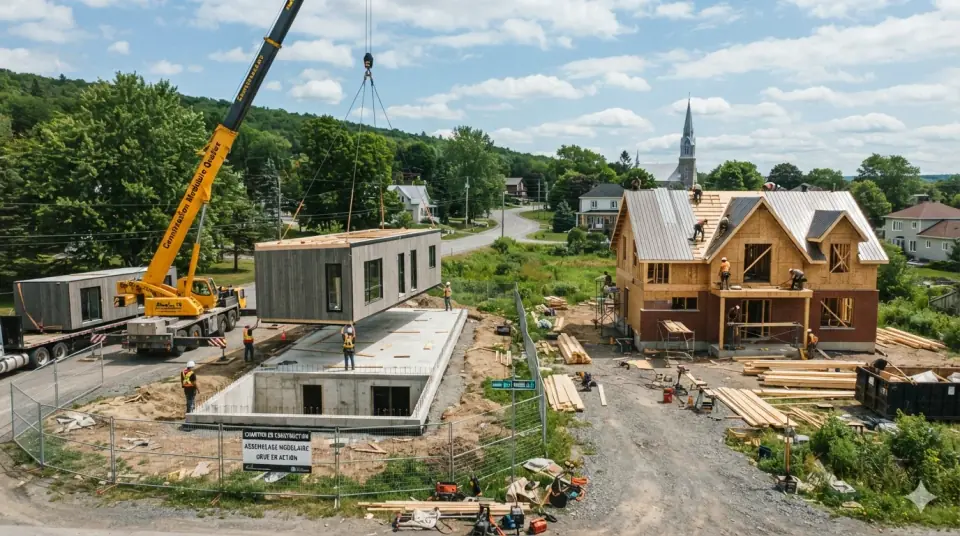
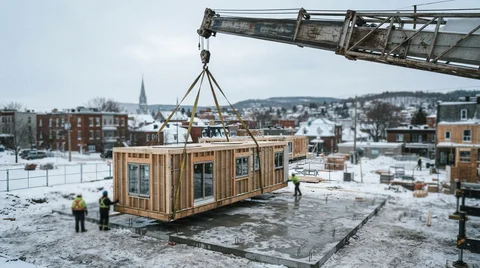
In modular, manufacturing the modules happens in parallel with site preparation and the foundation. The job site becomes an assembly of a few days rather than a construction lasting several months. On a permanent foundation, this is a real building — not a mobile home — as What is modular construction? explains.
Costs: really less expensive?
Modular is often more economical, but not always. The cost advantage comes mainly from speed (less on-site labour, fewer months of construction financing) and reduced material waste in the factory.
Be aware, however, of the line items that do not disappear: the land, the foundation, utility connections, module transport, and the crane are all added on top of the base price. Always compare equivalent products — a modular "turnkey" against a traditional "turnkey," not against a "ready-to-finish." A breakdown of costs by type and region is in our modular home price guide for Quebec.
"Modular construction does not win on price per square foot: it wins first on time — and time costs money."
Quality: where the real difference lies
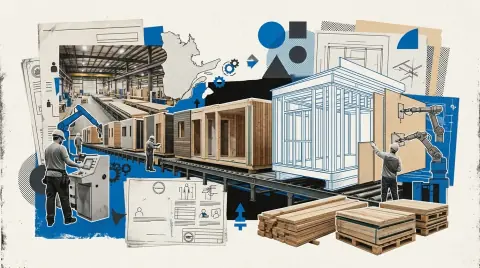
In the factory, the building is constructed under cover, away from rain, snow, and frost — which reduces the risk of moisture trapped in the materials. Production follows a line with inspections at every stage, where traditional construction depends more on the rigour of each crew on the day and the conditions of the moment.
That said, final quality depends above all on the builder, not the method. A good traditional builder delivers an excellent home; a careless modular builder can disappoint. The method reduces certain risks; it does not replace the seriousness of the company.
Financing and warranties
Good news: on a permanent foundation, a modular home is generally eligible for a conventional mortgage, on the same terms as a traditional home. The important distinction is not "modular vs. traditional" but "on a foundation vs. mobile home." A mobile home, without a permanent foundation, follows different financing rules.
Always confirm the type of financing with your lender before signing — common pitfalls are detailed in our guide modular home mortgage and financing. On the warranty side, modular is covered by the same warranty plans applicable to new residential construction in Quebec.
Resale value
Another common misconception: that prefabricated homes sell for less. In practice, built to Code and well maintained, these homes resell at values comparable to traditional homes in most regions of Quebec. Location and finish quality carry far more weight than the manufacturing method.
How to choose between the two
- Choose modular if timeline is critical (selling another property, growing a rental portfolio, a tight deadline), if your site is exposed to the elements, or if you want a predictable budget and schedule.
- Choose traditional if you are aiming for total customization (bespoke architecture, a very atypical site, complex geometry) and timeline is not pressing.
For an honest read of the strengths and limitations of modular before deciding, read the advantages and disadvantages of modular construction.
In summary
- The fundamental difference: factory (modular) vs. job site (traditional).
- Modular wins mainly on timeline and predictability.
- On price, the advantage often exists but must be compared product to product.
- At equivalent grade: same Code, same financing, same warranty, same value on a foundation.
Sources: Régie du bâtiment du Québec (Construction Code), APCHQ, CMHC — Canada Mortgage and Housing Corporation. Article written by Jeremy Soares. Last updated: June 24, 2026.

8Module
Modular multi-residential buildings (6 to 24+ units) factory-built in Quebec.
Visit websiteCommercial partnership — we receive compensation. Disclosure
Frequently asked questions
Is a modular home less expensive than a traditional home?
Is the timeline really shorter with modular?
Is financing different for a modular home?
Is factory quality really better?
Sources
- Quebec Construction Code — Régie du bâtiment du Québec (RBQ)
- Residential Construction Data — APCHQ
- Housing Market and Financing — CMHC — Canada Mortgage and Housing Corporation


Comments
A question or comment on this article? The comments section will be enabled soon.