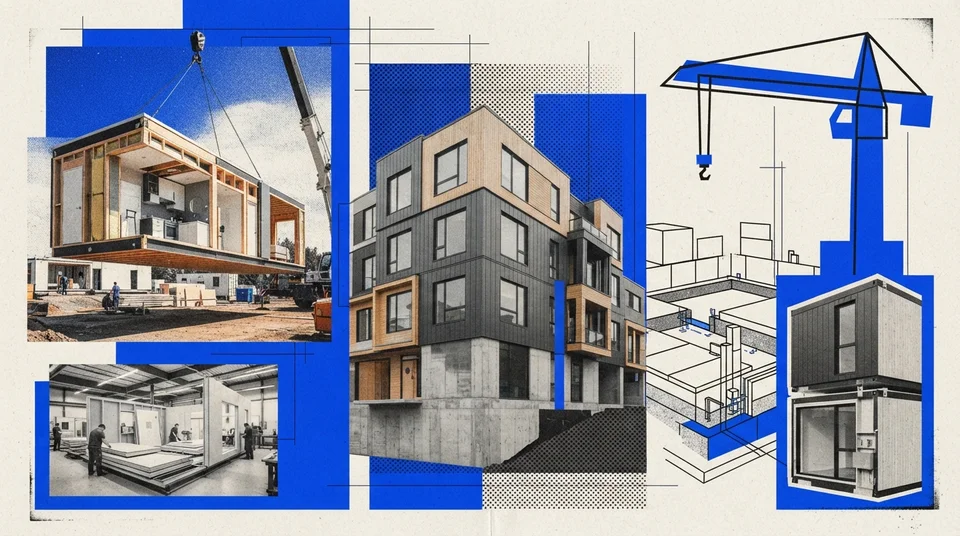
Commercial · 19 min
Commercial and Multi-Unit Modular Construction in Quebec
In short — Commercial and multi-unit modular construction involves manufacturing a building's modules in a factory — rental building, multiplex, student residence, offices, temporary structure — then assembling them on site. For a developer or investor in Quebec, the benefits are concrete: faster time to market (meaning rental income sooner), more predictable costs, and fewer on-site disruptions. This guide covers uses, costs, ROI, regulations, and key players.
The residential market has popularized the modular home with the general public. But it is in commercial and multi-unit projects that the modular economic equation is often strongest — and, paradoxically, this is the segment least well served by French-language content in Quebec. For a developer, the logic differs from that of an individual buyer: it is not about personal taste, but about schedule, carrying costs, and return.
This guide is written for that reader. Each section gives the direct answer, then points to the in-depth article.
Why modular changes the equation in multi-unit
Repetition is modular's best friend. A rental building is essentially the same module — a unit — repeated dozens of times. This is precisely the use case where factory production delivers its full benefit: standardization, cadence, quality control, economies of scale.
Three financial levers explain the appeal:
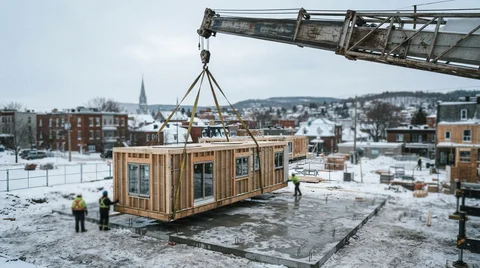
- Time is revenue. In traditional construction, the land and financing "sit idle" during months of on-site work. In modular, the foundation and site infrastructure are built while the building is being manufactured at the factory. The modules arrive ready; the building is enclosed within a few weeks. Every month gained is a month of rent collected sooner and a month of carrying costs saved.
- Cost predictability. A major portion of the building is produced under a fixed factory contract, sheltered from weather and on-site labour uncertainties. This reduces overruns — the No. 1 enemy of a pro forma.
- Reduced disruption. Less time on site means fewer disturbances in dense urban areas, an argument that carries weight for infill projects and municipal approvals.
Key takeaway — In multi-unit projects, modular does not sell itself primarily on cost per square foot, but on schedule. The time gain translates directly into return.
For the investor-side numbers, see modular rental building: ROI.
Main uses
Modular covers a much broader range of uses than the single-family home.
| Use | Why modular fits | Article |
|---|---|---|
| Rental building / multiplex | Repeating units, fast time to market | Modular multiplex |
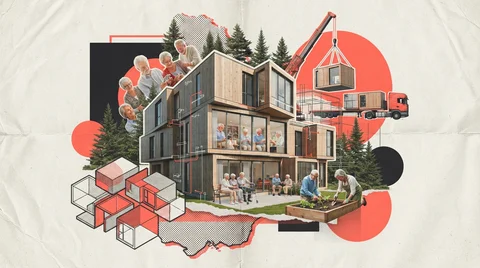
| Student residence / housing | Cadence, delivery aligned with the academic calendar | Student Housing |
| Affordable housing / non-profit | Controlled cost, rapid large-scale deployment | Affordable housing |
| Commercial building | Offices, retail spaces, standardized functional spaces | Commercial Modular Building |
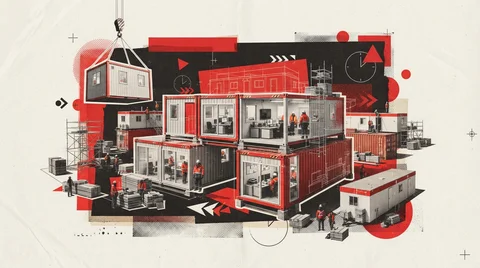
| Temporary / site buildings | Fast deployment and removal, reusable | Commercial Modular Building |
The common thread across all these uses: a repeating program or a need for speed. The more a project repeats a base unit, the stronger the modular advantage.
How much does it cost, and how to read a cost
As with residential, the ex-factory price is only part of the story. For a commercial or multi-unit project, total cost breaks down into major components:
- The building (modules) ex-factory — the portion that benefits from economies of scale.
- Land and site infrastructure — servicing, utilities, parking.
- Foundation and site structure — variable depending on height and soil conditions.
- Transport and lifting — convoys, crane, urban logistics (often underestimated in dense areas).
- Soft costs — design, engineering, permits, financing, fees.
The cost per square foot of a well-scoped modular project is generally competitive against traditional construction at equivalent quality — but the decisive advantage shows up in total cost carried over time, once the schedule gain is factored in. That is why a savvy investor compares full pro formas, not isolated per-square-foot prices.
For the cost and return mechanics, see modular rental building: ROI and, for structural trade-offs, wood or steel structure.
Wood or steel: the structural choice
In multi-unit and commercial projects, the choice of structural system for the modules has consequences for cost, permissible height, fire resistance, and logistics.
- Wood (light-frame, CLT/mass timber) is preferred for low-to-medium-rise residential: economical, fast, strong thermal performance, and increasingly accepted at height thanks to engineered wood products.
- Steel is the go-to for large spans, greater heights, and demanding commercial uses: robustness, stackable modules, fire performance.
This is not an ideological choice but an engineering calculation based on the program. The detail of those trade-offs can be found in wood or steel structure.
Regulations and project financing
A commercial or multi-unit modular building is subject to the Quebec Construction Code in the same way as a conventional building — structural requirements, fire safety, accessibility, energy efficiency. Factory production is governed by CSA A277 certification, which attests to continuous quality control. On-site work (foundation, connections, assembly, junctions) remains subject to municipal inspections and permits.
On the project financing side, two points deserve a developer's attention:
- The disbursement profile. A significant portion of payment is due to the manufacturer before installation — so the financing structure (construction-then-permanent, or a purpose-built project loan) must recognize advances paid to the factory. Lenders familiar with modular know how to structure this; others will need upfront education.
- Housing programs. For affordable housing and certain multi-unit projects, public programs (particularly through CMHC — Canada Mortgage and Housing Corporation) can support financing; modular's fast delivery schedule aligns well with the rapid-deployment objectives of those programs.
For the detailed regulatory framework, see modular construction and the Régie du bâtiment du Québec (RBQ, Quebec's building authority).
Timelines: the real argument
Let's return to the central point, because it is the one that most often justifies the B2B decision.
| Phase | Traditional | Modular |
|---|---|---|
| Design and permits | Comparable | Comparable |
| Foundation and site | Sequential | In parallel with factory |
| Building construction | On site, exposed to uncertainty | In factory, under controlled conditions |
| Building enclosure | Progressive over months | A few weeks after delivery |
| Time to market / revenue | Later | Earlier |
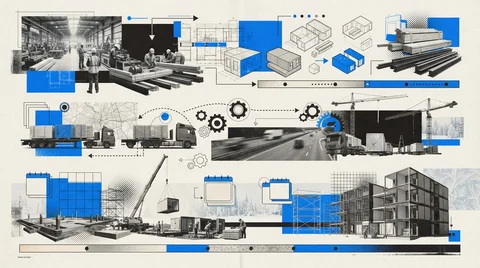
The overlap of the foundation (on site) and production (at the factory) is the core of the gain. For an investor, moving the rental date forward by several months directly changes the project's internal rate of return. That is what the comparison modular vs. traditional quantifies in detail.
Choosing a partner for a project of this scale
For a commercial or multi-unit project, selection criteria go beyond those for a single-family home:
- Production capacity and track record on projects of your scale and use type.
- CSA A277 certification and the appropriate RBQ licence for the project type.
- Financial strength of the manufacturer — a partner producing your building must be able to maintain the pace and the warranty over time.
- Engineering and integration capacity: who coordinates design, foundation, transport, and assembly? A single point of responsibility reduces risk.
- Logistics: site access for convoys and crane, particularly in urban settings.
In the multi-unit sector, Quebec manufacturers such as 8Module — specializing in projects from 6 to 24 units up to 100 units and more — serve developers and non-profits looking to compress the schedule. To understand the ecosystem of manufacturers, engineering firms, and installers, see the players in modular construction.
Disclosure — 8Module is a commercial client of Modulaire Québec; we receive compensation when we refer a lead. This content remains editorial and independent — 8Module neither commissioned nor reviewed it. Full disclosure.
Sources: Régie du bâtiment du Québec (Quebec Construction Code), CSA Group (CSA A277 standard), CMHC (housing programs and financing). Guide written by Jeremy Soares. Last updated: June 25, 2026. Dollar amounts, returns, and timelines cited are indicative ranges to be validated before any commitment.

8Module
Modular multi-residential buildings (6 to 24+ units) factory-built in Quebec.
Visit websiteCommercial partnership — we receive compensation. Disclosure
Frequently asked questions
Is modular construction truly profitable for a rental building?
Can modular buildings be built tall in Quebec?
Does a commercial modular building meet the same standards as a traditional building?
How do you finance a large-scale modular project?
Which uses are best suited to modular?
Is modular suitable for projects in dense urban areas?
Sources
- Quebec Construction Code — Régie du bâtiment du Québec (RBQ)
- Prefabricated Construction Standards (CSA A277) — CSA Group — Canadian Standards Association
- Housing Programs and Project Financing — CMHC — Canada Mortgage and Housing Corporation
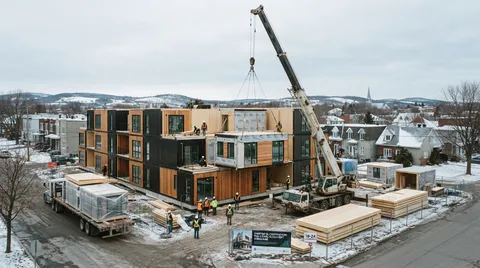
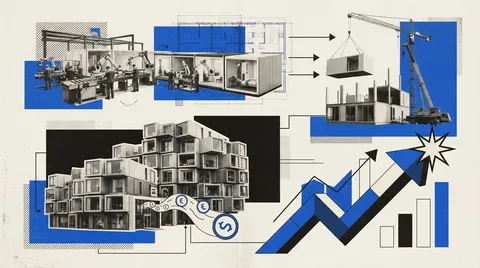

Comments
A question or comment on this article? The comments section will be enabled soon.