
Fundamentals · 10 min
The Stakeholders in Quebec's Modular Construction Industry
In short — A modular construction project in Quebec involves at least eight types of stakeholders: manufacturers, municipalities, architects or professional technologists, developers or landowners, investors, nonprofits and housing offices, real estate brokers, and the final buyers or tenants. Understanding each one's role helps avoid delays, liability disputes, and budget surprises.
Modular construction is often described as a straightforward relationship between a buyer and a manufacturer. In practice, a project — even a single-family home — involves more parties than most people expect at the outset. For a multi-unit building or a community project, that network gets considerably more complex.
This guide maps each stakeholder and their respective role. It's written for the individual buyer who wants to understand who they'll be dealing with, and for the developer or nonprofit looking to plan every player in a larger project.
Manufacturers and factories: where it all begins
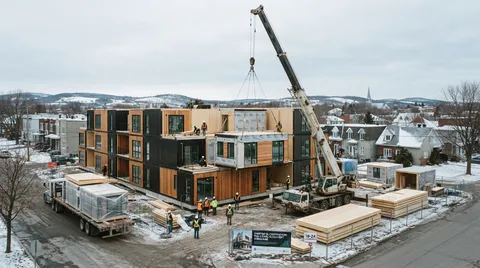
The manufacturer is the technical heart of modular construction. They translate the architectural plans into buildable modules, produce those modules in the factory, deliver them to site, and — depending on the contract — supervise or perform the assembly.
What the manufacturer does:
- Translate architectural drawings into fabricable modules
- Build the modules in the factory, to Quebec's Building Code
- Coordinate factory inspections at each structural stage
- Deliver by semi-trailer and oversee the crane placement
- Provide compliance documentation (RBQ, warranties)
What the manufacturer generally does not do:
- Acquire the land or manage municipal permits
- Build the foundation (with rare exceptions)
- Handle hookups to municipal services
- Complete interior finishing (in a ready-to-finish shell formula)
Quebec manufacturers are concentrated in a handful of regions — primarily Chaudière-Appalaches, Estrie, and the Laurentians. Each has its strengths: some specialize in single-family residential, others in multi-unit or commercial projects. Our guide to choosing a builder covers the selection criteria.
The relationship with the manufacturer is often the most consequential one in the entire project. A good manufacturer anticipates transport, zoning, and foundation constraints before the contract is signed — not after.
Municipalities: the right to say yes (or no)
The municipality is the unavoidable local regulatory authority. Even if the home is built 400 kilometres away, it is the municipality where it will be installed that issues the building permit, enforces the zoning bylaws, and carries out on-site inspections.
What the municipality controls:
- Zoning (residential, commercial, agricultural) — a modular home is not permitted everywhere, notably on farmland protected by the CPTAQ
- Setback requirements (minimum distances from the road, neighbours, and waterways)
- Permitted building envelopes (maximum height, footprint)
- Regulations on exterior cladding materials (some municipalities set their own standards)
- Issuance of the building permit
- Inspection of the foundation, hookups, and final finishing
What the municipality does not control:
- The quality of factory production (that falls to the RBQ for inspection or certification)
- The Quebec Building Code itself (administered by the RBQ)
A well-prepared modular project submits its permit application before ordering the modules, not after. Permit processing times vary widely — a few weeks in some cases, several months in others. That timeline must be factored into the project schedule.
The RBQ and the Building Code: technical authority
The Régie du bâtiment du Québec (RBQ) is not a local stakeholder — it is the provincial authority that sets and enforces technical standards. The Quebec Building Code (Code de construction du Québec), which the RBQ administers, applies to all construction on Quebec soil, whether site-built or factory-produced.
In the modular context, the RBQ plays two distinct roles:
-
It certifies or inspects modules in the factory — depending on the applicable program, modules can be inspected at each manufacturing stage, before the walls are closed. This is one of modular's advantages: the structure is verified during construction, not only at the end.
-
It oversees building inspectors — municipalities sometimes delegate their inspections to engineers or technologists certified by the RBQ.
Our article Modular Construction and Quebec's Building Code (RBQ) details the applicable standards and the obligations specific to modular construction.
Architects and professional technologists: design and compliance
A modular project may or may not require an architect, depending on its nature.
When an architect is mandatory:
- Any non-residential building above a certain floor area
- Residential buildings with multiple units (subject to the thresholds in the Code of Professions)
- Projects funded by government programs (which often require a professional stamp)
When a professional technologist may be sufficient:
- A single-family home or small duplex, depending on current regulations
- Projects using standard plans from the manufacturer, already validated
Concrete role in a modular project:
- Adapting the manufacturer's standard plans to the site and municipal requirements
- Producing the drawings submitted for the permit (manufacturers often have partners for this)
- Supervising on-site assembly compliance
- Signing the certification documents required by the RBQ or financing programs
The relationship between the architect and the manufacturer is a frequent friction point in modular projects. An architect who has never worked with modular manufacturers may impose requirements that are difficult to integrate into the production process. Choosing a professional with experience in the field speeds things up considerably.
Real estate developers: project owner in multi-unit construction
The developer finances, coordinates, and delivers a multi-unit project — rental building, condominium, or turnkey project sold to a third party. In the modular context, they play a central role: they identify the opportunity, secure the land, arrange financing, select the manufacturer, and coordinate every other stakeholder.
What the modular developer does:
- Feasibility analysis and financial modelling (rental returns, costs, timelines)
- Land acquisition and zoning approval
- Manufacturer selection and contract negotiation
- Coordination of architects, engineers, brokers, and building managers
- Bank financing and/or government programs
- Marketing or rental management at delivery
The appeal of modular for a developer is primarily financial: a building assembled in a few weeks rather than several months generates rental income sooner and reduces carrying costs (interest on construction financing). For a look at the returns on a modular rental building, see our modular multiplex guide.
Investors: from capital to returns
In larger projects, the developer often brings in outside investors — private, institutional, or impact funds. Modular presents a specific proposition for these partners.
What the investor evaluates differently in modular:
- Time to occupancy — a building delivered faster generates income sooner; the IRR (internal rate of return) improves even when the cost per square foot is similar
- Construction risk — delays and cost overruns are generally better controlled in modular than in site construction, which reduces carrying risk
- Quality of mechanical systems — the factory environment allows for more thoroughly documented quality control, which can improve financing terms or warranty coverage
Institutional investors (pension funds, real estate asset managers) are increasingly interested in modular construction as part of large-scale rental housing portfolios. Long-term performance data remains less abundant than for traditional construction, but trends point toward growing adoption.
Nonprofits and housing offices: community housing
This is a segment where modular construction takes on particular meaning. Nonprofit housing organizations (ONBLs), housing cooperatives, and OMH (municipal housing offices) build affordable units — often on tight budgets with deadlines set by government funding programs.
What draws nonprofits to modular:
- Predictable costs (the manufacturer commits to a firm price upfront)
- Shorter delivery times — critical when subsidy programs have hard deadlines
- Thermal and energy performance that is often superior, reducing long-term operating costs
The specific challenges for nonprofits:
- Nonprofit project financing typically flows through government programs (SHQ, SCHL, federal) that carry their own design and documentation requirements
- Approval processes are more demanding than in the private sector
- Coordinating the financing program, the manufacturer's schedule, and municipal permits requires rigorous management
Our section on nonprofit and affordable modular housing explores these projects in depth.
Landowners: often underestimated
In modular development projects, the landowner can be a passive actor (selling the land to a developer) or an active one (looking to maximize the value of their lot by having a rental building constructed on it).
The active landowner:
- Holds a buildable lot and wants to maximize its value
- May choose to partner with a developer, self-finance a project, or hand management to a property manager
- Must confirm that the zoning allows the intended project type before ordering modules
The passive landowner:
- Sells the land to a developer or buyer
- Has no further role in the construction project
In either case, the quality of the land — servicing, topography, zoning, soil — directly affects the feasibility and cost of the modular project. A poorly serviced lot or one with difficult soil can erase modular's cost advantage entirely.
Real estate brokers: marketing and advice
The real estate broker enters a modular project at two points.
At land purchase: a commercial or residential broker who knows the local market can identify buildable lots suited to a modular project, anticipate zoning constraints, and estimate the future value of the developed property.
At resale or leasing: a broker who understands both the local market and the modular product can present the property to better advantage. A broker who lacks product knowledge can, conversely, undermine the listing.
Brokers also have a role in correcting misconceptions. A buyer hesitating over a modular home may be reassured — or put off — depending on how well their broker understands the product. This is an education and information challenge for the industry as a whole.
Summary table: who does what
| Stakeholder | Primary role | Key point of contact |
|---|---|---|
| Manufacturer | Production, delivery, assembly | Early in the project |
| Municipality | Zoning, permits, local inspections | Before ordering |
| RBQ | Building Code standards, factory certification | Through the manufacturer or architect |
| Architect / professional technologist | Plans, compliance, professional stamp | Design and permits |
| Developer | Coordination, financing, marketing | Project owner |
| Investor | Capital, returns, risk | Project financing |
| Nonprofit (OBNL) / Housing office (OMH) | Community housing, subsidies | Affordable projects |
| Landowner | Land, value creation, partnership | Development stage |
| Real estate broker | Land purchase, resale, leasing | Local market |
Sources: Régie du bâtiment du Québec, Société d'habitation du Québec, SCHL. Article written by Jeremy Soares. Last updated: June 24, 2026.

8Module
Modular multi-residential buildings (6 to 24+ units) factory-built in Quebec.
Visit websiteCommercial partnership — we receive compensation. Disclosure
Frequently asked questions
Do you need an architect to build a modular home in Quebec?
Who is responsible if a module is defective after delivery?
Can a municipality reject a modular home on aesthetic grounds?
Can a nonprofit access the same financing programs as a private developer?
How do you choose a trustworthy modular developer?
Sources
- Loi sur le bâtiment et réglementation de la construction — Régie du bâtiment du Québec (RBQ)
- Programmes d'aide à la construction de logements abordables — Société d'habitation du Québec (SHQ)
- Données sur la mise en chantier et le financement résidentiel — SCHL (Société canadienne d'hypothèques et de logement)



Comments
A question or comment on this article? The comments section will be enabled soon.