
Fundamentals · 9 min
Modular Structure: Wood or Steel?
In short — For a modular structure, wood is the most common choice in residential construction: less expensive, lighter, naturally better thermal behaviour, and fast to manufacture. Steel takes over mainly in multi-unit and commercial applications: it offers greater spans, supports more storeys, and handles heavier loads. The right choice depends on the size of the building and its intended use — not on a universally "winning" material.
Wood or steel? It is one of the most frequently asked technical questions as soon as you go beyond a single-family home. Both materials produce excellent modular buildings; they simply do not serve the same needs. Here is how to tell them apart.
Comparison table
| Criterion | Wood structure | Steel structure |
|---|---|---|
| Cost (material) | Generally lower | Generally higher |
| Weight | Light | Heavier |
| Spans / height | Good (residential, small multi-unit) | Excellent (large buildings) |
| Thermal insulation | Good (low thermal bridging) | Thermal bridges must be addressed |
| Fire behaviour | Designed and protected per the Code | Fire-rated protection required |
| Typical use | Home, cottage, small multiplex | Multi-unit, commercial, industrial |
| Carbon footprint | Often more favourable | Higher (but fully recyclable) |
Wood: the standard for residential modular
Wood framing dominates modular home construction in Quebec, and for good reasons.
- Cost. Wood is generally more affordable and assembles quickly in the factory.
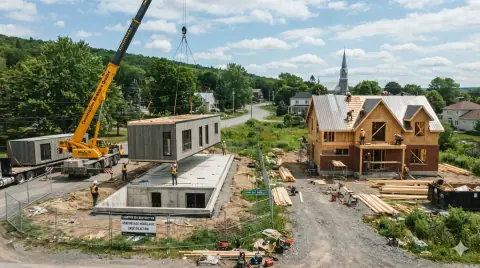
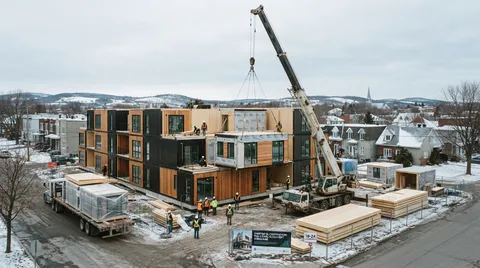
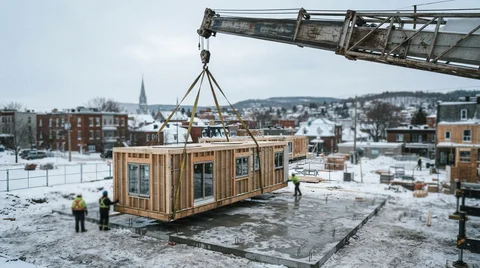
- Weight. Lighter, it eases module transport and crane manoeuvres — two important constraints in modular construction, as covered when weighing the advantages and limitations of modular construction.
- Thermal performance. Wood conducts little heat: it naturally limits thermal bridges, a real advantage in Quebec winters.
- Footprint. A renewable material, wood often has a better carbon balance than steel.
Its limitations emerge as buildings grow larger: for long spans or many storeys, conventional wood framing runs into constraints that steel handles more readily (mass timber systems are evolving, but remain more specialized).
Steel: the structure of choice for multi-unit and commercial
Structural steel takes over when load, span, or height increases.
- Spans and height. Steel supports larger openings and more storeys — useful for a rental building or a commercial structure.
- Transport robustness. Steel modules absorb the repeated lifting stresses of a large project well.
- Durability. Unaffected by insects and rot, steel is fully recyclable.
The trade-offs: it is heavier (more demanding transport and crane requirements), more expensive as a material, and requires addressing thermal bridges as well as appropriate fire-rated protection — all elements governed by the Quebec Construction Code, as detailed in our guide Modular Construction and the Quebec Construction Code (RBQ).
"The wood-versus-steel debate has no universal winner: it has a winner per project."
Fire safety: a question of design, not material
A common misconception holds that wood "burns" and steel is "fireproof." The reality is more nuanced. Structural wood, dimensioned and protected per the Code, behaves predictably in a fire (it chars slowly at the surface while retaining its load-bearing capacity for a certain time). Steel does not burn, but loses strength at high temperatures: it requires fire-rated protection. In both cases, it is Code-compliant design — not the material alone — that ensures safety.
Insulation and comfort in the Quebec climate
In Quebec, thermal performance is not a minor detail: it determines comfort and heating costs. This is a point where wood starts with a built-in advantage. Because it conducts little heat, it limits thermal bridges — those zones where the structure bleeds energy. A well-insulated wood frame easily reaches strong thermal resistance levels without special measures.
Steel, an excellent conductor, creates thermal bridges that must be interrupted by continuous insulation (exterior insulation, for example) to prevent heat loss and condensation. This is entirely achievable and well understood, but it adds a design requirement and a cost. The good news in modular construction: because insulation is installed in the factory, under dry conditions, it is better controlled than on a site exposed to frost and rain — an advantage that applies to both materials.
How to choose: size and use decide
- Single-family home, cottage, tiny home, small multiplex → wood is almost always the right choice: cost, weight, and thermal performance all favour it.
- Multi-storey rental building, commercial or institutional project → steel (or a mixed wood-steel structure) becomes relevant for the spans, height, and loads involved.
- Modular multi-unit project → the decision is made with the builder based on the number of storeys and the structural grid; see our guide Building a Modular Multiplex in Quebec.
Many projects also adopt a mixed approach: wood framing for the modules, steel elements at high-load points. The "or" in the title is often an "and" in practice.
In summary
- Wood dominates residential: less expensive, lighter, better thermal performance, favourable carbon balance.
- Steel takes over in multi-unit and commercial applications: spans, height, loads.
- Fire safety depends on Code-compliant design, not the material alone.
- The choice is made according to size and use — and mixed structures are common.
Sources: Régie du bâtiment du Québec (Quebec Construction Code), APCHQ, CMHC — Canada Mortgage and Housing Corporation. Article written by Jeremy Soares. Last updated: June 24, 2026.

8Module
Modular multi-residential buildings (6 to 24+ units) factory-built in Quebec.
Visit websiteCommercial partnership — we receive compensation. Disclosure
Frequently asked questions
Wood or steel: which is better for a modular structure?
Is a wood modular structure safe in a fire?
Why does modular multi-unit construction often use steel?
Is a wood structure less durable than steel?
Sources
- Quebec Construction Code (structural and fire requirements) — Régie du bâtiment du Québec (RBQ)
- Wood Construction and Structural Systems — APCHQ
- Building Performance and Materials — CMHC — Canada Mortgage and Housing Corporation


Comments
A question or comment on this article? The comments section will be enabled soon.