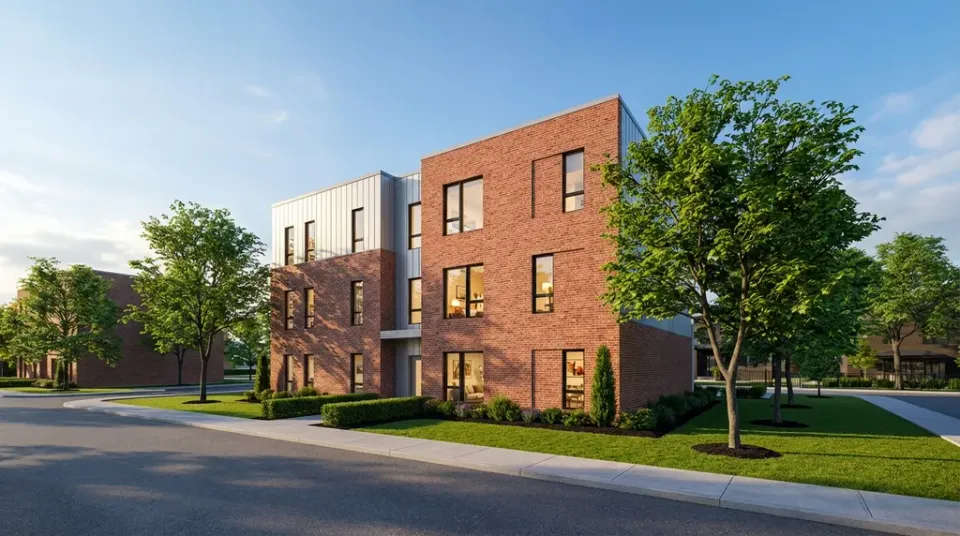
Multi-residential · 7 min
Le Petit Matane: A 6-Unit Modular Multiplex in Downtown Matane
Disclosure — 8Module, the developer of the project described here, is a commercial partner of this site: we receive compensation when quote requests are passed along to it. This portrait remains editorial — 8Module neither commissioned nor reviewed it — but read it knowing that relationship exists. Details.
In short — Le Petit Matane was a 6-unit modular multiplex project announced for downtown Matane, in the Bas-Saint-Laurent, by the builder 8Module. Designed to be factory-built with a wood frame, it illustrated a model that Quebec's small towns need: densifying a town core with new housing, delivered fast, without a traditional job site that drags on. A portrait of the concept, the announced timeline, and what this type of project reveals — including its risks.
Update (July 2026): the project will not go ahead. We are keeping this portrait as a case study of the presale model in modular multi-residential. The details below describe the project as announced by the developer in January 2026.
The project at a glance
| Element | Announced detail (January 2026) |
|---|---|
| Location | Downtown Matane (Bas-Saint-Laurent) |
| Program | 6 units in a multiplex |
| Method | Wood modular construction, factory-built |
| Announced price | From $299,000 |
| Announced timeline | Modules assembled in a few days, turnkey installation in about 2 months; delivery then targeted for fall 2026 |
| Targeted certifications | Novoclimat, Energy Star, RBQ and CSA A277 compliance |
| Status | Project cancelled — was in the preliminary phase (purchase and rental reservations) at the time of writing |
The figures in this table come from the official project website as consulted in January 2026 and were developer claims, not verified job-site results.
Why a modular 6-plex in the downtown of a regional town?
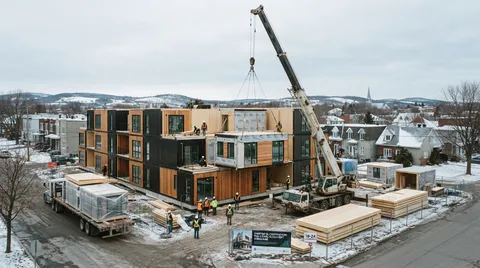
Matane has about 14,000 residents. Like many Quebec towns of that size, it combines a real need for new housing with a limited pool of general contractors available for multi-residential projects — exactly the context where modular multiplex construction makes the most sense: the modules are factory-built, transported, then assembled on the foundations in a few days.
The choice of the downtown is no accident. A small multiplex on an existing central lot densifies without sprawl, close to services — the kind of gentle infill that municipalities are looking for, and one of the recurring arguments for modular in the face of the housing crisis.
What the announced timeline illustrates
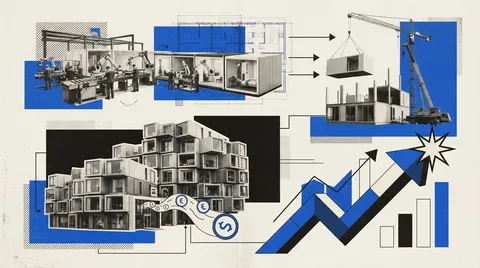
The developer announced module assembly "in 4 days, not 3 months" and a turnkey installation "in 2 months". These are developer figures — to be read as a commercial promise, not independent data. They nonetheless illustrate the real mechanics of modular: most of the building is manufactured in the factory while the site is prepared in parallel, which compresses the calendar compared with a sequential job site. To understand what is realistic by project size, see our guide on modular project timelines and scheduling.
Another structural detail: the project was in a preliminary phase, with construction starting only once a threshold of buyers and tenants was reached. This is a common presale model in small-scale multi-residential: it protects the developer, but it also means an announced project may never break ground if local demand fails to materialize fast enough — which is precisely what happened here: the project did not go ahead.
Certifications: the most verifiable part
The project targeted RBQ and CSA A277 compliance — the factory certification that is mandatory to sell or lease a factory-built building in Quebec — as well as Novoclimat and Energy Star for energy performance. For a buyer, these certifications are the most objective part of a project sheet: they can be verified with the certifying bodies, unlike timeline promises. The developer also claimed a "50% GHG reduction", an environmental claim that, for its part, requires methodology and verification.
What to take away for a similar project in your town
Whether you are a buyer, an investor, or a municipal official, a project like Le Petit Matane is a useful reading grid:
- The 6-unit format is the entry point of modular multi-residential — small enough for a downtown lot, large enough to amortize transport and craning. Our analysis of the profitability of a modular rental building details that economics.
- Separate the verifiable facts (certifications, RBQ licence, permits) from the promises (timelines, savings, GHG) — and ask for proof of the latter.
- Presale is a two-way risk: it conditions the project's financing, but also its very existence.
Editorial portrait based on the project's public information. 8Module is a commercial partner of this site — disclosure.

8Module
Modular multi-residential buildings (6 to 24+ units) factory-built in Quebec.
Visit websiteCommercial partnership — we receive compensation. Disclosure
Frequently asked questions
Was Le Petit Matane a traditional or modular construction project?
How much did a unit at Le Petit Matane cost?
What is the CSA A277 certification the project mentioned?
Could a model like this apply to other regional towns?
Sources
- Le Petit Matane — official project website — Le Petit Matane / 8Module
- CAN/CSA-A277 certification (prefabricated buildings) — Régie du bâtiment du Québec
- Novoclimat program — Gouvernement du Québec




Comments
A question or comment on this article? The comments section will be enabled soon.