
Multi-residential · 8 min
Case Study: 155 Modular Student Housing Units Delivered in 10 Months in Rimouski
In short — In Rimouski, the non-profit UTILE delivered 155 student housing units near UQAR in about 10 months: announcement in October 2024, module installation starting January 14, 2025, first tenants on July 1, 2025. Reported cost: about $30 million. It is, to date, Quebec's best-documented case of modular multi-residential construction at scale — and the best local proof that the method delivers on its core promise: time.
International studies measure speed gains of 20 to 50% for modular. But for a non-profit board or a Quebec municipal council, nothing replaces a local, public, verifiable case. The rue Alcide-C.-Horth project is one. Here are the facts, their sources, and what can — and cannot — be concluded from them.
The project at a glance
| Element | Detail | Source |
|---|---|---|
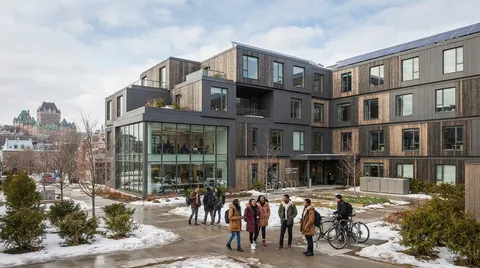
| Program | 155 student housing units (126 studios + 29 two-bedroom units), for about 180 students | UTILE |
| Location | Rue Alcide-C.-Horth, near UQAR, Rimouski | Radio-Canada |
| Sponsor | UTILE, a non-profit specialized in student housing | UTILE |
| Design and fabrication | Modules built by Industries Bonneville (Belœil plant); architecture Blouin Beauchamp; engineering gbi | Radio-Canada |
| Reported cost | About $30 million | Radio-Canada |
| Affordability | Rents capped for a minimum of 35 years | UTILE |
| Overall timeline | About 10 months, from announcement to first tenants | Portail Constructo |
The players are named here as documented by public media coverage; this is not a supplier recommendation.
The timeline: what actually happened, and when
- October 2024 — public announcement of the project by UTILE.
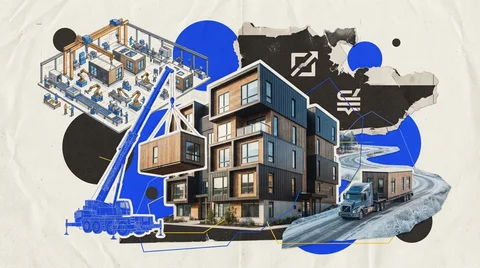
- Fall 2024 — module fabrication in the factory, in Belœil, while the site is prepared in Rimouski. That is the key to the method: the two work streams advance in parallel.
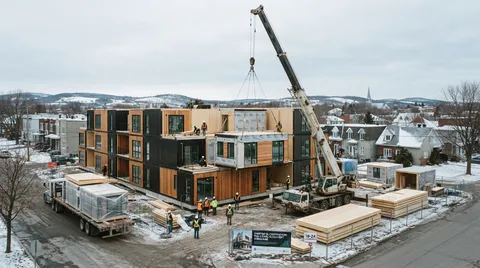
- January 14, 2025 — start of on-site assembly, in the middle of winter, with roughly one month of installation targeted (Journal Le Soir).
- July 1, 2025 — arrival of the first tenants, in time for the fall 2025 semester.
The Portail Constructo sums it up: 155 units "delivered in 10 months thanks to modular construction." Two details are worth underlining. First, the modules were installed in January — modular neutralized the classic Quebec-winter objection, since most of the building was already built under cover. Second, delivery was pegged to a real imperative: the academic year. For student housing, delivering in November means losing a year — we dig into that constraint in our feature on modular student housing. And Rimouski's need is not letting up: on June 19, 2026, UQAR for its part opened 25 affordable four-bedroom student units — a separate $11.7-million project funded through the PHAQ, whose announcement does not specify the construction method (Education News Canada).
In the factory: the manufacturer's numbers, with the necessary quotation marks
According to the manufacturer, whose facilities have been visited by journalists, the Belœil production line has 16 workstations and produces one module — that is, two units of about 500 sq. ft. — in roughly 32 hours (La Presse); in Rimouski, the targeted installation pace was about 8 modules per day (Radio-Canada). These figures come from a stakeholder — they are reported here as manufacturer statements, not as independent measurements. They nonetheless illustrate the industrial logic of the method: a continuous production flow, decoupled from the weather and the site calendar.
The same caution applies to the project's most quoted line: "We estimate we saved at least half the construction time," according to Laurent Levesque, UTILE's executive director (Radio-Canada). That is a satisfied developer's assessment, not a study. But it is consistent with the available independent measurements: the U.S. DOE-funded field study of more than 50 multi-family buildings measured deliveries 25 to 30% faster on average (Modular Building Institute), and McKinsey put the range at 20-50% as early as 2019. Rimouski, at 10 months, sits at the top of those ranges — helped by an experienced sponsor and a heavily standardized design.
The financing package: multi-source, and partially documented
Transparency requires it: the exact funding breakdown is only partially established in public sources, and reported figures diverge. According to published information:
- a contribution from the SHQ of $4.7 million and up — about 15% of construction costs, according to UTILE; Radio-Canada has, however, also mentioned a Quebec contribution of nearly $10 million, a gap public coverage does not allow us to settle (a topped-up contribution or a different envelope);
- a contribution from the City of Rimouski of about $715,000, including the value of the land;
- $250,000 from UQAR's student association via the Fonds CLÉ;
- a loan of about $20.7 million (Capital social d'investissement immobilier).
Remember the structure more than the amounts: a non-profit stacking a provincial grant, a municipal contribution (land included), a community down payment and a main loan. That is the standard template of the Quebec affordable projects that get built — we detail it program by program in our guide to funding affordable modular housing. And the affordability commitment is long: rents capped for a minimum of 35 years, according to UTILE.
What Rimouski demonstrates — and for whom
That modular works at multi-residential scale in Quebec. Not a prototype, not a 12-unit pilot: 155 units, four professional players (non-profit, manufacturer, architects, engineers), a Bas-Saint-Laurent winter, and a non-negotiable delivery date — met.
That speed is an affordability tool. Fewer months of construction means less interim interest, less exposure to cost inflation, and rental income that starts sooner — dynamics we quantify in our article on the profitability of a modular rental building.
That non-profits can carry this type of project. The method is not reserved for large private developers. For a municipality or non-profit looking at its needs — student housing, workers, families — Rimouski provides a concrete precedent to cite before a board or a municipal council. Project sponsors looking for a Quebec manufacturer specializing in this type of multi-residential building will find 8Module as an example of a player positioned for projects ranging from 6 to 24 units up to 100 units and more. The broader context is covered in our feature on modular construction and the housing crisis.
Disclosure — 8Module is a commercial client of Modulaire Québec; we receive compensation when we refer a lead. This content remains editorial and independent — 8Module neither commissioned nor reviewed it. Full disclosure.
The limits of the demonstration
One case, however excellent, is not a general law. Three honest caveats:
- The cost is not the proof. About $30 million for 155 units is a public figure, but without a traditional comparable run in parallel, it does not demonstrate cost savings. The independent literature urges caution: modular's direct savings depend on market and scale; the robust gain is time.
- The conditions were favourable. A specialized, experienced sponsor, a highly standardizable typology (repetitive studios), a site backed by the municipality. A family project on a constrained site would not necessarily go as fast.
- The financial documentation is incomplete. As long as the gap between the reported provincial contribution figures is not publicly resolved, the package must be presented as partially documented — which is what we do here.
Sources: UTILE (release, October 2024), Radio-Canada (January 2025 and project announcement), Portail Constructo, Journal Le Soir, La Presse (December 2025), Modular Building Institute / U.S. DOE (2024), McKinsey & Company (2019). Article written by Jeremy Soares. Last updated: July 3, 2026.

8Module
Modular multi-residential buildings (6 to 24+ units) factory-built in Quebec.
Visit websiteCommercial partnership — we receive compensation. Disclosure
Frequently asked questions
Was the Rimouski project really delivered in 10 months?
How much did the project cost?
Will the rents really be affordable?
Can this model be replicated elsewhere in Quebec?
Sources
- 155 logements abordables pour les étudiants seront construits rapidement à Rimouski — UTILE
- Logement étudiant à Rimouski : le chantier modulaire près de l'UQAR — Radio-Canada
- Annonce du projet UTILE-Bonneville à Rimouski — Radio-Canada
- UTILE Rimouski : 155 logements étudiants livrés en 10 mois grâce à la construction modulaire — Portail Constructo
- UTILE : le chantier à la vitesse supérieure à Rimouski — Journal Le Soir
- Des logements construits en 32 heures — La Presse
- Modular Multi-Family Construction: A Field Study — Modular Building Institute (étude financée par le U.S. DOE)
- Official opening of affordable housing units for students at the Université du Québec à Rimouski — Education News Canada

Comments
A question or comment on this article? The comments section will be enabled soon.