
Multi-residential · 8 min
Workforce Housing in the Regions: The Modular Solution
In short — In many regions of Quebec, work exists but housing is scarce — and without housing, you cannot recruit. Modular construction offers a direct response: a rental building delivered in months rather than years, at a controlled cost, placed exactly where the need is real. It is an economic development tool as much as a real estate project.
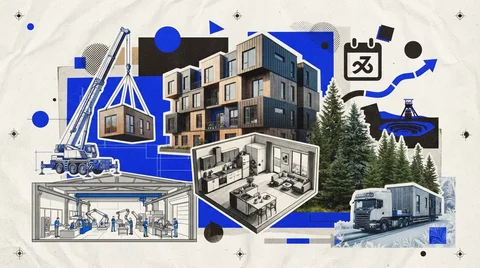
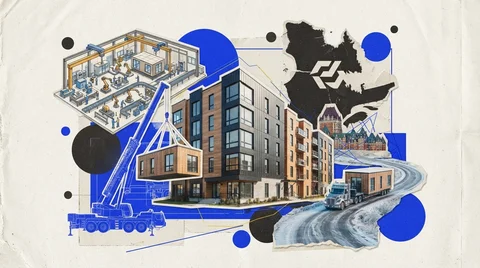
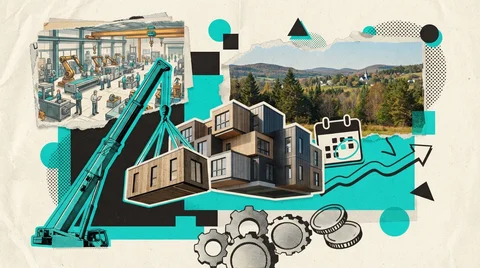
The regional labour shortage has a less-discussed face: you cannot attract workers to places where they have nowhere to live. Employers, municipalities, and developers are looking for fast solutions. Modular construction is one of the few that responds on the same timeline as the problem.
Why modular addresses this need
- Speed. The need for housing follows the need for labour — immediate. Factory fabrication, running in parallel with site work, compresses a timeline that, with traditional construction, would often outlast the useful window.
- Predictability in the regions. Building in a remote municipality, with scarce on-site labour, is more predictable when the bulk of the work happens in a factory.
- Repetition. Similar units, repeated: the ideal use case for a factory.
For the financial mechanics on the developer side, see modular rental building ROI and the commercial and multi-unit pillar.
Who carries this type of project
| Sponsor | Rationale |
|---|---|
| Employer | House its workforce to recruit and retain |
| Municipality | Support population and business attraction |
| Developer | Meet a real and underserved regional rental demand |
| Partnership | Employer + municipality + developer, often the winning structure |
The form ranges from a multiplex to a small rental building, or even residence-style housing units. Depending on the need, see also modular multiplex and student housing, whose logic is similar.
Regulation and financing
The building is subject to the Quebec Construction Code like any rental building; factory fabrication is governed by CSA A277 certification (CSA Group — Canadian Standards Association). On the financing side, certain projects — especially those with an affordable housing mandate — may draw on housing programs from Société d'habitation du Québec (SHQ, Quebec's housing agency) and CMHC (Canada Mortgage and Housing Corporation), whose criteria change regularly. For the affordable and community housing angle, see modular affordable community housing.
Key takeaway — For an employer, the calculation is not purely real estate: it is the cost of not housing workers — unfilled positions, contracts turned down, blocked growth. Housing becomes recruitment infrastructure.
The regional angle: exactly where modular wins
This need is dispersed — it exists across dozens of municipalities, rarely in the major urban centres. That is precisely the profile where modular is most relevant: fast, predictable deployment in places where traditional construction struggles to mobilize on-site labour. Manufacturers such as 8Module, specializing in multi-unit housing from 6 to 24 units, deliver exactly this format in these regional contexts.
Disclosure — 8Module is a commercial client of Modulaire Québec; we receive compensation when we refer a lead. This content remains editorial and independent — 8Module neither commissioned nor reviewed it. Full disclosure.
Sources: Régie du bâtiment du Québec (Quebec Construction Code), Société d'habitation du Québec (housing programs). Guide written by Jeremy Soares. Last updated: June 25, 2026. Programs and eligibility criteria must be verified with the relevant official bodies.

8Module
Modular multi-residential buildings (6 to 24+ units) factory-built in Quebec.
Visit websiteCommercial partnership — we receive compensation. Disclosure
Frequently asked questions
Can an employer build housing for its workers?
Why modular rather than traditional for this need?
Are there funding supports for this type of project?
What form does this housing take?
Sources
- Quebec Construction Code — Régie du bâtiment du Québec (RBQ)
- Housing Programs — Société d'habitation du Québec (SHQ)

Comments
A question or comment on this article? The comments section will be enabled soon.