Multi-residential · 11 min
Building a Modular Multiplex in Quebec (6, 12, 24 Units)
In short — Yes, modular multiplexes of 6, 12 or 24 units are being built today in Quebec. The modules — complete, factory-finished units or half-units — are assembled on the foundation in a matter of days. Typical result: a building delivered in approximately 8 months rather than 14 to 18 months with conventional construction. The main advantage is not the price per square foot: it is time — and therefore carrying costs and earlier occupancy.
For a developer or investor, the question is no longer "is this possible?" but "does it hold up financially, and how does the project actually unfold?" This guide answers both. It is aimed at those evaluating a rental project of 6 to 24 doors — or more — who want to understand the timelines, cost per door, process, zoning and financing before committing.
Why modular changes the equation in multi-unit construction
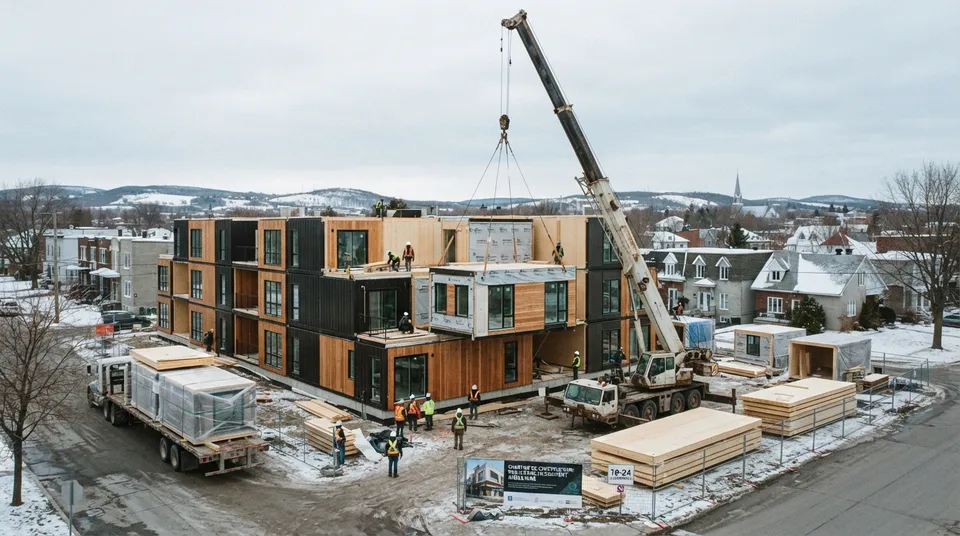
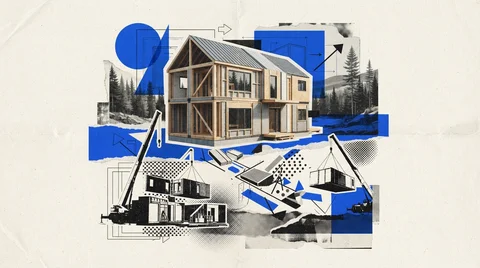
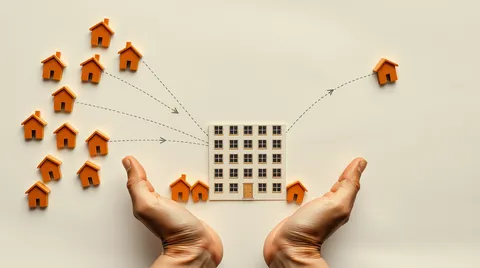
In single-family housing, modular construction saves a few months. In multi-unit projects, the gap widens, for a simple reason: repetition. A 24-unit building typically uses 4 or 6 repeated module types. The factory produces those modules on a production-line basis, in parallel with site preparation and the foundation. While excavation and formwork are under way on site, the units are already being built under shelter.
The job site then becomes an assembly rather than a full build from scratch. Once the modules are delivered, the skeleton of the building can be erected in a matter of days. Everything else — connections, joint finishing, facade, landscaping — follows. This parallelism is what explains the schedule difference.
"In multi-unit construction, what modular is really selling is a schedule. Every month saved is a month less of carrying costs and a month more of rental income."
Timelines: the primary differentiator
The following figures are the ranges most commonly cited for a multi-unit project in Quebec. These are indicative ranges to be validated project by project — size, site complexity and municipal permit timelines all carry significant weight.
| Phase | Modular | Conventional construction |
|---|---|---|
| Design + drawings + permits | 2 to 4 months | 2 to 4 months |
| Factory fabrication (in parallel with site work) | 3 to 5 months | — |
| On-site module assembly | A few days to 2 weeks | — |
| On-site construction (structure to finishes) | — | 10 to 15 months |
| Signed contract → building ready to rent (estimate) | approx. 8 months | 14 to 18 months |
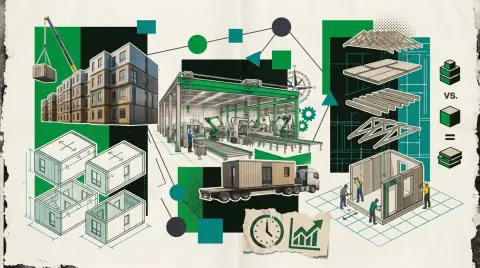
Factory fabrication does not extend the schedule: it runs during site preparation. That is where the months are saved. For a detailed look at what happens in the factory versus on site, see our guide on modular, manufactured and prefabricated homes.
Cost per door: how to read it correctly
Cost cannot be compared by square foot in isolation. In multi-unit construction, the useful unit of measure is cost per door (per unit) — and what that includes varies enormously from one project to the next.
Three main components:
- The modules themselves (factory-finished units) — this is where modular concentrates its savings, through serial production and reduced material waste.
- The land, foundation and connections (water, sewer, electricity) — independent of the construction method; they depend on the site.
- On-site assembly, finishing and landscaping — the portion of the work that stays on site.
The classic trap: comparing a "modules only" price to a "turnkey" conventional price. Those are two different things. Before assessing a cost per door, always insist on a detailed list of what is included and excluded. For a breakdown of price per square foot and typical ranges by project type, see our modular construction pricing guide.
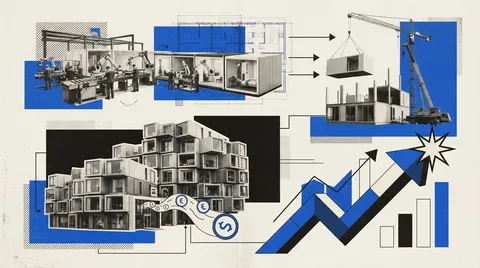
The real financial advantage of modular in multi-unit construction often comes less from the raw construction cost than from the schedule: fewer months of carrying costs (interest on the construction loan), faster occupancy, and therefore earlier rental income. We detail this calculation in our guide on modular rental building profitability.
The process, step by step
1. Feasibility and site. Validate zoning (density, height, setbacks), municipal service capacity and site access — because modules arrive by flatbed truck and must be lifted by crane. A landlocked or difficult-access site can complicate delivery.
2. Design and drawings. Architecture is planned for modularity from the start: module dimensions compatible with transport, repeated unit types, lifting points. The earlier the design "thinks modular," the more efficient the project.
3. Municipal permit. A modular building is subject to the same requirements as a conventional building: construction permit, zoning compliance, and compliance with the Quebec Construction Code. This is not a regulatory shortcut.
4. Factory fabrication + site preparation (in parallel). Modules are built under shelter while excavation, formwork and foundation pouring are under way. This is the phase that compresses the schedule.
5. Delivery and assembly. Modules are transported, then lifted by crane and fixed to the foundation. The structural shell of the building takes shape in a matter of days.
6. Finishes, connections and commissioning. Module junctions, facade, building mechanical systems, landscaping, final inspections. The building is then ready to rent.
Zoning, regulations and warranties
Three points every developer must verify:
- Municipal zoning. Modular construction bypasses no density, height or use rules. Validate the zoning grid before anything else.
- Quebec Construction Code. A modular multi-unit building is designed and inspected according to the Code; for buildings of more than 4 units or several storeys, specific requirements (fire resistance, exits, seismic) apply — as in conventional construction.
- RBQ licence. The builder must hold the appropriate licence from the Régie du bâtiment du Québec (RBQ, Quebec's building authority). Verify it before signing.
Financing: what developers need to know
Financing a modular rental project resembles financing a conventional one, with one nuance around the disbursement schedule: a significant portion of value is created at the factory, before on-site assembly. Some lenders are comfortable with this model; others are less so. Have an early conversation with your institution about the structure of construction-phase advances.
On the program side, CMHC (Canada Mortgage and Housing Corporation) offers rental housing financing products (including affordable housing) that can apply to modular projects. For projects with a community or affordable-housing mandate, other levers exist — see our guide on modular construction for affordable and community housing.
In summary
- Modular multiplexes of 6, 12 and 24 units (and more) are being built in Quebec — 8Module is one example of a Quebec manufacturer specializing in these configurations.
- The key advantage is timeline: approximately 8 months versus 14 to 18 in conventional construction, because the factory works in parallel with the site.
- The right cost indicator is cost per door — always validate what is included.
- No regulatory shortcuts: permits, zoning, the Quebec Construction Code and an RBQ licence all apply just as in conventional construction.
- The financial advantage comes mainly from the schedule — less carrying, rental income sooner.
Disclosure — 8Module is a commercial client of Modulaire Québec; we receive compensation when we refer a lead. This content remains editorial and independent — 8Module neither commissioned nor reviewed it. Full disclosure.
Sources: Régie du bâtiment du Québec (Quebec Construction Code), CMHC — Canada Mortgage and Housing Corporation (rental housing financing), APCHQ (Quebec's association of construction and housing professionals). Article written by Jeremy Soares. Last updated: June 24, 2026.

8Module
Modular multi-residential buildings (6 to 24+ units) factory-built in Quebec.
Visit websiteCommercial partnership — we receive compensation. Disclosure
Frequently asked questions
Can a 24-unit building really be built with modular construction in Quebec?
How long does it take to deliver a modular multiplex?
Does modular construction cost less per door than a conventional building?
Does a modular building comply with the Quebec Construction Code?
What factors can slow down or complicate a project?
Sources
- Quebec Construction Code — Régie du bâtiment du Québec (RBQ)
- Rental Housing Financing Programs — CMHC — Canada Mortgage and Housing Corporation
- Residential Construction Data — APCHQ (Quebec's association of construction and housing professionals)
Comments
A question or comment on this article? The comments section will be enabled soon.