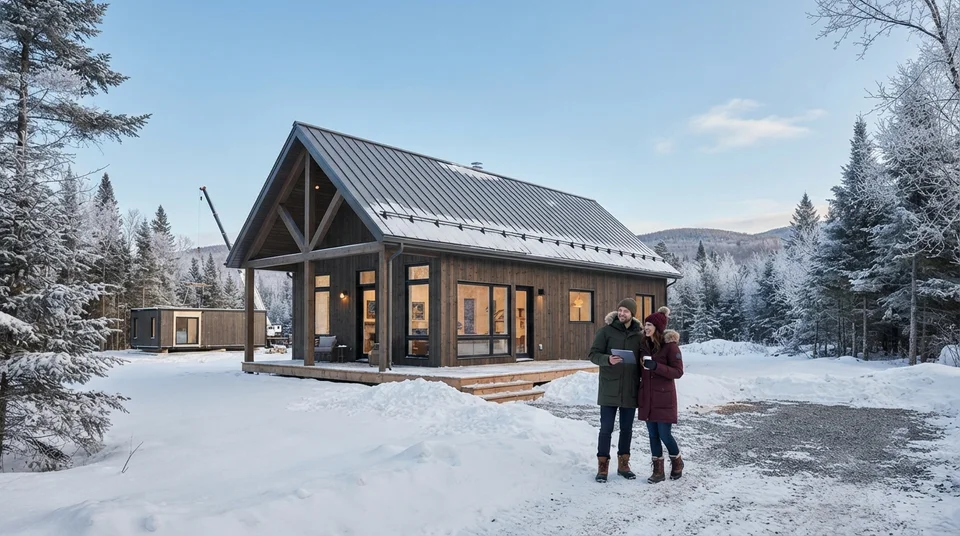
Residential · 18 min
Modular Home in Quebec: The Complete Guide
In short — A modular home is a dwelling built in complete sections (the modules) inside a factory, then transported and assembled on a permanent foundation. In Quebec, it is subject to the Quebec Construction Code like any other home, can be financed through a standard residential mortgage once set on a foundation, and generally costs less and is delivered faster than equivalent traditional construction. This guide covers everything: definitions, prices, financing, regulation, steps, lifespan, and how to choose your builder.
Modular homes have a reputation problem in Quebec, and that problem stems largely from a misunderstanding of terminology. "Modular," "manufactured," "prefab," "mobile home": these terms are used interchangeably in everyday conversation, yet they describe different legal, technical, and financial realities. Understanding these distinctions alone eliminates three-quarters of the bad decisions people make.
This guide is designed as a single starting point. Each section answers the question directly first, then points to the detailed article for anyone who wants to go deeper.
Modular, manufactured, prefab: what are we actually talking about?
The word prefabricated is the umbrella term: it covers anything built in a factory before arriving on site. Within that broad family, the main distinctions are:
| Type | How it is built | Status in Quebec |
|---|---|---|
| Modular home | Complete three-dimensional modules, assembled on a permanent foundation | Standard building |
| Manufactured home (panel) | Walls and floors in panels, assembled on site | Standard building |
| Mobile home | Wheeled chassis, not permanently fixed | Distinct regime |
The decisive difference is not appearance — it is permanent anchoring on a foundation. A modular home set on a foundation is, in the eyes of the law, financing institutions, and municipal assessment, a home like any other. A mobile home is not — and that explains most of the gaps in resale value and mortgage conditions.
For a full breakdown of these distinctions, see our dedicated article: modular, manufactured, or prefab home.
How much does a modular home cost in Quebec?
It's the number-one question, and the honest answer starts with a qualification: the price depends on the level of finish you are buying. There are generally three formulas.
- Ready-to-finish: the shell delivered and closed (structure, roofing, windows, sometimes insulation), to be completed afterward. The per-square-foot cost is the lowest, but you need to budget for the finishing work.
- Turnkey: the complete home, move-in ready, finishes included.
- Custom / high-end: personalized plans, premium materials — the top of the range.
On top of that, there are always items the factory does not supply: the land, the foundation, utility connections (water and sewer, or well and septic system, electricity), transport, the crane for assembly, and municipal fees (permits, taxes). These "off-factory" items can represent a significant share of the total budget and vary considerably from one region to another.
Key takeaway — The price a manufacturer advertises is almost always the cost of the building ex-factory. The total project cost includes land, foundation, connections, transport, and fees — always compare on the same basis.
For detailed price ranges by type and region, as well as our cost calculator, see the article on modular home price in Quebec and the page on turnkey vs ready-to-finish.
Financing a modular home: mortgage and steps
The good news: once set on a permanent foundation, a modular home is financed through an ordinary residential mortgage, with the same insurance (CMHC and others) as a traditional home. The value is recognized, and the amortization is standard.
The nuance lies in disbursement. Because a significant portion of the payment is due to the manufacturer before the home is on your land, financing often resembles a construction loan: staged advances (deposit at order, payment at production, balance at delivery/assembly), converted into a permanent mortgage once the home is in place and inspected. Coordinating your financial institution and the manufacturer from the outset is essential.
The detail on disbursement stages, down payments, and common pitfalls can be found in our article on financing and mortgage.
Regulation: RBQ, Quebec Construction Code, and factory standards
A modular home in Quebec must comply with the Quebec Construction Code — exactly like a home built on site. Being assembled in a factory gives it no exemption, nor does it impose any additional requirement on the expected final quality.
Two mechanisms govern quality:
- Factory certification (standard CSA A277) attests that the manufacturer produces under a monitored quality-assurance program. It is the industrial equivalent of a site inspection: continuous control at the factory rather than periodic checks on the ground.
- The Régie du bâtiment du Québec (RBQ, Quebec's building authority) licence held by the contractor carrying out the project (manufacturer, installer, or general contractor depending on the arrangement), along with the usual municipal permits.
Work done on site — foundation, connections, assembly — remains subject to local inspection. For the full regulatory detail, see modular construction and RBQ.
Project steps, from planning to move-in
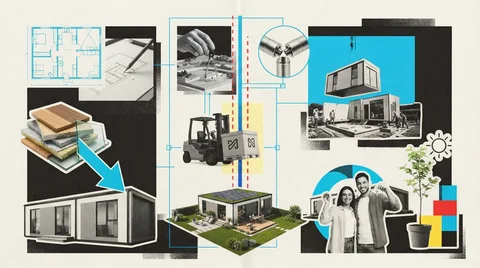
A modular home project follows a fairly predictable sequence. That predictability is, in fact, one of its advantages: the "factory" portion is planned and largely insulated from weather disruptions.
| Step | What happens | Who is involved |
|---|---|---|
| 1. Land and budget | Land purchase/validation, soil study, overall budget | Buyer, broker, land surveyor |
| 2. Plans and specifications | Model selection, customization, contract signing | Manufacturer, buyer |
| 3. Financing | Construction loan / coordinated mortgage | Financial institution |
| 4. Permits | Municipal permit, approved connections | Municipality |
| 5. Foundation | Permanent foundation poured on site | Local contractor |
| 6. Factory production | Module construction in a controlled environment | Manufacturer |
| 7. Transport and lifting | Module delivery, crane assembly | Manufacturer, crane operator |
| 8. On-site finishing | Connections, joints, finishing work, inspection | Contractor, inspector |
| 9. Move-in | Handover, warranties | Buyer |
The key difference from traditional construction: steps 5 (foundation) and 6 (production) happen in parallel. While the foundation is curing on your land, your home is already being built at the factory. That is where the time saving comes from.
Modular or traditional: how to decide
Modular is not universally superior — it is a trade-off with clear strengths and real limitations.
Where modular wins: timelines (factory production and site work running in parallel), cost predictability (fixed factory quote), consistent construction quality (controlled environment, no weather exposure during manufacturing), and less material waste.
Where to be careful: the land must allow access for an oversized transport convoy and a crane; customization is more constrained than on a traditional site; and the land, foundation, and connections remain "conventional" line items that do not benefit from the factory advantage.
For a line-by-line cost comparison, see modular vs traditional construction and the advantages and disadvantages breakdown.
Lifespan, maintenance, and resale value
This is the most persistent myth: "a modular home doesn't last and won't resell." The documented reality is the opposite. A modular home set on a permanent foundation and built to Code has a lifespan comparable to a traditional home — several decades, with the normal upkeep of any dwelling.
On resale, the determining factor remains permanent anchoring: on a foundation, the home is assessed and sold like any other property, based on the local market, condition, and location — not on any bias toward its construction method. The detail (material aging, maintenance points, resale behaviour) is covered in lifespan and resale value.
Choosing your builder: the questions that matter
The choice of manufacturer is the most consequential decision in the project. A few non-negotiable checkpoints:
- Valid RBQ licence, in good standing and verifiable in the public registry.
- Factory certification (CSA A277) for modular production.
- Clear warranties: what is covered, by whom, and for how long — including the distinction between the factory warranty and the warranty on on-site work.
- Contract scope: what is included (and especially what is not — foundation, transport, connections).
- References and completed projects in your region.
The full list of questions to ask before signing is found in how to choose your builder, and a comparison of the main players in the best builders in Quebec.
Sources: Régie du bâtiment du Québec (Quebec Construction Code), CMHC (mortgage financing), CSA Group (CSA A277 standard). Guide written by Jeremy Soares. Last updated: June 25, 2026. All figures cited are indicative ranges to be validated before any commitment.

8Module
Modular multi-residential buildings (6 to 24+ units) factory-built in Quebec.
Visit websiteCommercial partnership — we receive compensation. Disclosure
Frequently asked questions
Is a modular home less expensive than a traditional home?
Can you get a standard mortgage for a modular home?
How long does it take to build and install a modular home?
Does a modular home comply with the Quebec Construction Code?
Are modular homes and mobile homes the same thing?
Is customization possible?
Sources
- Quebec Construction Code — Régie du bâtiment du Québec (RBQ)
- Housing and Mortgage Financing — CMHC — Canada Mortgage and Housing Corporation
- Prefabricated Construction Standards (CSA A277) — CSA Group — Canadian Standards Association



Comments
A question or comment on this article? The comments section will be enabled soon.