Multi-residential · 10 min
Modular Construction for Developers: Cost per Door, Timelines, and Profitability
In short — For a developer, the business case for modular is not primarily about price: it is about time. Independent studies put the schedule gain between 20% and 50%, and every month gained is a month of rent collected sooner and a month of financing costs saved. On costs, honesty is required: direct savings in the range of 10% to 20% are documented in markets where labour is expensive, but elsewhere, cost parity is the more realistic expectation. Profitability turns on speed and predictability, not on a magic discount per square foot.
If you develop rental properties in Quebec — plex, mid-density building, student housing, or workforce residence — you have probably already received a pitch touting modular at "20% cheaper." That figure comes from marketing, not from studies. This guide revisits the question with the available independent sources and a developer's perspective: product, timeline, financing, risks.
The real investment thesis: speed of lease-up
In a rental project, construction cost is only part of the equation. The other part, often underestimated, is the cost of time: interim interest, taxes and insurance during construction, uncollected rent, exposure to cost inflation and rate increases. Modular attacks precisely that part.
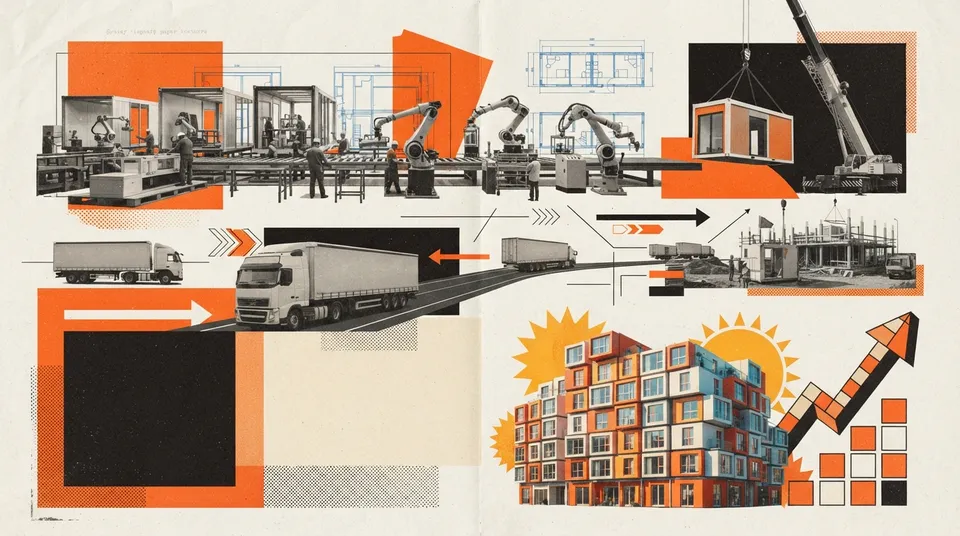
The mechanism is structural: factory manufacturing of the modules runs in parallel with foundation and site work. Two workstreams advance simultaneously instead of sequentially. The data converge:
- McKinsey (2019, a reference still cited worldwide) puts the project schedule reduction at 20% to 50% compared to traditional construction;
- a field study funded by the U.S. Department of Energy, covering more than 50 multifamily buildings, measures projects completed 25% to 30% faster on average than comparable on-site builds;
- in Canada, CMHC — Canada Mortgage and Housing Corporation cites the case of 605 Studio West in Calgary: 84 affordable units built and occupied in under a year, versus nearly two years for a comparable conventional project in the same neighbourhood.
Translate that into pro forma language: occupancy advanced by several months, meaning revenues advanced accordingly, a compressed interim interest period, and a faster conversion to permanent financing. In a rental market where demand remains strong, the ability to deliver a season earlier can be worth more than a few points of construction cost. Our rental building profitability analyses detail how to integrate this variable into the project structure.
The other benefit, less spectacular but just as bankable, is schedule certainty. Manufacturing under cover eliminates most weather-related risk — a non-trivial factor for anyone who has poured foundations in November in Quebec — and factory production, station by station, reduces execution variability. For a detailed look at the stages and durations, see our article on the timelines and schedule of a modular project.
Cost per door: what modular changes — and what it doesn't
Let's speak plainly about cost per door, since that is the question every developer asks first. Three observations stand out.
First observation: there is no universal cost per door for modular. Cost per door depends on typology (studio or 5½), finish level, land, infrastructure, region, and the tendering context — exactly as in conventional construction. Be wary of anyone who quotes a single figure without first asking what you are building and where. Our reference on pricing for commercial and multi-unit buildings explains how to frame the question correctly.
Second observation: the direct saving is real but contextual. Independent sources (Urban Institute, NIBS, McKinsey) put direct savings at roughly 10% to 20% in markets where labour is expensive and scarce — and at parity, or even a slight premium, elsewhere. The logic is intuitive: modular replaces on-site hours with factory hours; the more expensive local site hours are, the more the substitution pays off.
Third observation: the cost structure shifts. Even at the same total cost, modular distributes the money differently, and this distribution has consequences for your cash flow and financing:
| Line item | Conventional construction | Modular construction |
|---|---|---|
| Structure and building envelope | Built on-site, spread over months | Largely included in the factory price |
| Interior finishing | On-site, at the end of construction | Largely completed in the factory (kitchens and bathrooms often installed) |
| Transport and crane work | Marginal | A distinct, significant line item to budget for early |
| General site conditions | Extended (full construction duration) | Compressed (shorter site schedule) |
| Interim financing costs | Spread over the full duration | Reduced by the compressed schedule |
| Draw schedule | Progressive, in step with construction | Front-loaded (factory deposits before delivery) |
The last line deserves a pause: modular generally requires more equity, sooner. The factory demands deposits to launch production, often months before anything is visible on your lot — and before the usual draws from a lender that advances based on construction progress. This mismatch between the factory's schedule and the financing schedule is the main structuring challenge of a modular project. It is manageable, but it must be anticipated from the pro forma stage.
Financing: what changed in 2026
For a long time, the classic objection was: "lenders won't follow." That is changing. In May 2026, following a pilot that financed more than 800 modular rental units across five provinces, CMHC — Canada Mortgage and Housing Corporation extended its multi-unit mortgage insurance to modular construction across all of its products, including APH Select — the product most affordable rental developers know well. The agency also launched a product for buyers of prefabricated homes providing for progressive draws, a sign that the cash-flow timing particular to prefabricated construction is now recognized by the public insurer.
For a developer, the practical implications are as follows:
- a modular rental project can target the same insured financing structures as a conventional project — the "modular = uninsurable" argument is no longer valid;
- dialogue with the lender must nonetheless begin earlier, since the draw schedule must be aligned with the factory deposit schedule;
- the affordability and energy-efficiency commitments that improve the terms of insured products apply to modular just as to everything else — factory manufacturing can even make it easier to meet building envelope performance targets.
Risks and due diligence: the chapter not to skip
Modular does not eliminate development risk; it shifts it. Here are the watch points that recur in real projects.
The factory contract. This is the central document of the project. Verify: the exact scope (what is finished in the factory, what remains to be done on-site?), the production schedule and penalties or remedies in case of delay, dimensional tolerances, responsibility for transport and the crane lift, warranties, and the fate of your deposits if the manufacturer defaults (bank guarantees, surety bonds, clauses of ownership of modules during production). A substantial deposit paid to a factory without protection is your greatest exposure.
Dependence on a critical supplier. In conventional construction, a failing subcontractor can be replaced. In modular, the factory is difficult to replace mid-project. Due diligence on the manufacturer's financial health, order book, and references is not optional. Also verify licences and certifications: in Quebec, factory-built building manufacturing is governed by the CAN/CSA-A277 certification and the RBQ framework — our article on the Quebec Construction Code and the RBQ summarizes what to require.
Transport-to-crane sequencing. Setting the modules is a surgical operation: oversize transport permits, verified routing (clearance heights, bridges, turning radii), correctly sized crane, weather window, foundation ready and dimensioned precisely. A module that arrives before the foundation is ready costs dearly in storage; a foundation waiting for delayed modules costs dearly in interest. Factory-to-site coordination is the key discipline of the project — make sure someone clearly owns it, with the experience to do it.
The factory-to-site interface. Claims often arise in the grey zone between what the factory delivers and what the site contractor must complete: joints between modules, mechanical connections, corridors and common areas, unified exterior cladding. Require an explicit responsibility matrix, line by line, before signing.
A Quebec case study: 155 units in roughly ten months
The UTILE student housing project in Rimouski is the best-documented recent Quebec case: 155 units near the Université du Québec à Rimouski (UQAR), with modules manufactured in the factory in autumn 2024, assembled on-site starting January 2025, with first tenants taking occupancy July 1, 2025 — a delivery in roughly ten months from announcement to occupancy, according to media coverage of the project. The project lead publicly estimates having saved at least half the construction time; that is a stakeholder's claim, but the schedule itself is public and verifiable. For a developer, the lesson is not the exact figure: it is that a good-sized multi-unit building can go from announcement to occupancy within a single academic year — a horizon that changes business models, particularly in student housing and workforce housing, where the delivery date is everything. In Quebec, a manufacturer such as 8Module, which specializes in multi-residential projects from 6 to 24 units up to 100 units and more, addresses precisely this profile.
Disclosure — 8Module is a commercial client of Modulaire Québec; we receive compensation when we refer a lead. This content remains editorial and independent — 8Module neither commissioned nor reviewed it. Full disclosure.
The business verdict
Modular deserves a place in every Quebec rental developer's analysis, on three conditions: evaluate the gain where it actually is (time, predictability, advanced revenues — not an automatic discount per square foot); structure cash flow and financing around the factory's schedule; and invest in contractual due diligence as though it were your number-one risk exposure, because it is.
Sources: CMHC — Canada Mortgage and Housing Corporation (expansion of mortgage insurance to modular, May 2026; 605 Studio West case), McKinsey & Company (2019), Modular Building Institute / U.S. DOE (field study, 2024), Urban Institute, UTILE (Rimouski project). Article written by Jeremy Soares. Last updated: July 1, 2026.

8Module
Modular multi-residential buildings (6 to 24+ units) factory-built in Quebec.
Visit websiteCommercial partnership — we receive compensation. Disclosure
Frequently asked questions
Does modular really cost less per door?
Does CMHC finance modular projects?
What is the main risk of a modular project?
At what project size does modular become worthwhile?
Sources
- CMHC expands mortgage insurance support for prefab and modular construction — CMHC — Canada Mortgage and Housing Corporation
- Modular construction: From projects to products — McKinsey & Company
- Modular Multi-Family Construction: A Field Study — Modular Building Institute (study funded by the U.S. DOE)
- Encouraging modular construction could help address the housing shortage — Urban Institute
- 155 Affordable Student Housing Units to Be Built Quickly in Rimouski — UTILE



Comments
A question or comment on this article? The comments section will be enabled soon.