Non-profit · 8 min
Housing and Modular Construction in Montreal: The 2026 Picture
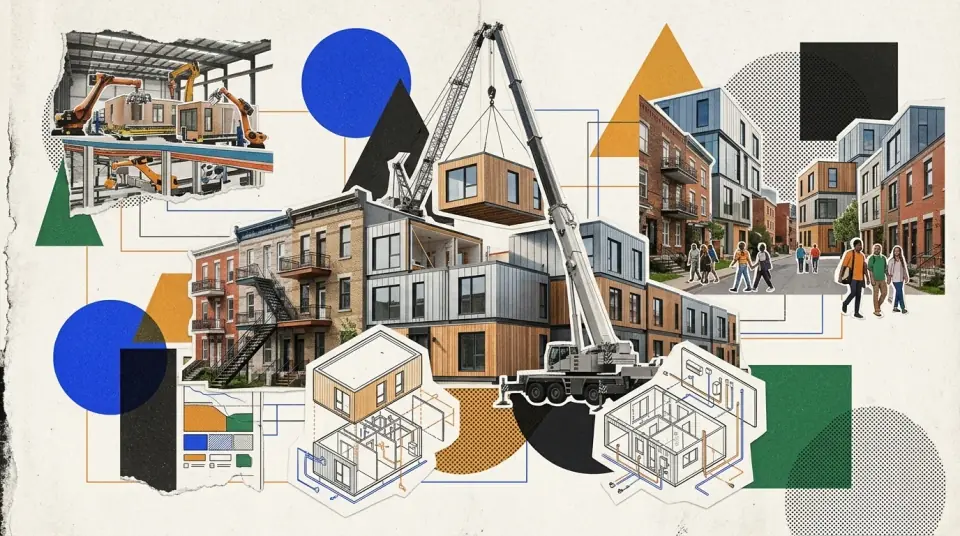
In short — Montreal has just delivered Quebec's fastest modular demonstration: the 26 units of Projet Acadie, installed in under 12 months — permits included — with tenants expected in October 2026. Meanwhile, the new mayor is replacing the Règlement pour une métropole mixte with a single requirement of 20% off-market housing, and Montreal rents have just jumped 7.2% in one year. The equation is simple: the city needs affordable housing, fast — exactly what modular knows how to deliver.
From its central neighbourhoods to the West Island — from Dorval to Sainte-Anne-de-Bellevue — Montreal concentrates both Quebec's most visible crisis and, as of recently, its fastest answers. Here is the 2026 picture, sourced figures in hand.
The housing situation in Montreal
CMHC's data (October 2025) tells the story of a deceptive easing. The Montreal CMA's vacancy rate rose back to 2.9% — but it drops to 1.3% in the most affordable rent quartile, versus 4.9% in the most expensive quartile (Radio-Canada). In other words: there are vacant units, just not the ones modest-income households are looking for.
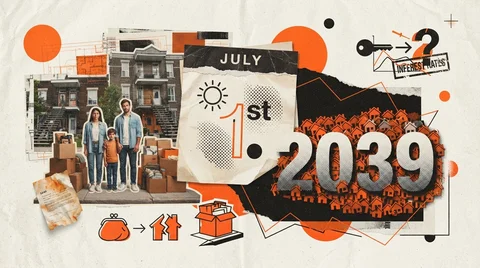
On the rent side, the average two-bedroom rent reached $1,346 per month, up 7.2% between October 2024 and October 2025 — after +6.3% the previous year (Le Devoir). CMHC finds that rent growth outpaced income growth in Greater Montreal. And a few days before July 1, 2026, more than 3,000 Quebec households were still looking for housing, concentrated in Montreal and Quebec City (Radio-Canada). The day after moving day, 2,039 households remained without a lease according to SHQ data reported by the media (CBC), while more than 200 affordable units remained merely "in development" in the metropolis (CTV News) — the full picture is in our article on the state of the housing crisis in 2026. The pressure does not stop at the central neighbourhoods: from Dorval to Sainte-Anne-de-Bellevue, the West Island is also looking for its densification solutions.
The new political course: the 20% off-market rule
Elected in November 2025, Mayor Soraya Martinez Ferrada (Ensemble Montréal) presented a "10 actions in 100 days" plan that changes Montreal's rules of the game (official release). Two structuring measures: the Règlement pour une métropole mixte (RMM) is replaced by a single requirement of 20% off-market housing, and 80 municipal lots are being offered to non-profit organizations (Radio-Canada). In June 2026, the City also freed up $540,000 to renovate, within two months, 45 vacant SHDM units intended for people experiencing homelessness.
The reform is not unanimous: Projet Montréal and community groups argue it weakens the production of social housing (Métro). The underlying debate — how much off-market housing, and who builds it — remains wide open.
Projet Acadie: Quebec's modular showcase
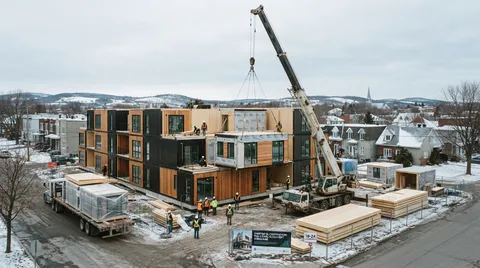
On June 18, 2026, Quebec confirmed that the 26 modular units of Projet Acadie — 17 studios and 9 family units — were installed at 7965 boulevard de l'Acadie (Québec.ca). The key figures: a total investment of about $10.1 million (including $3.7 million from the SHQ and $1.9 million from the City of Montreal), modules built by Les Industries Bonneville within the Magil-Tisseur consortium, tenants expected in October 2026 — and above all, a project wrapped up in under 12 months, permits included.
It is the flagship project of the SHQ's first call for 500 highly prefabricated housing units (11 winners, 336 units, announced in August 2025; 566 units selected in total after the second call). For a Montreal developer or non-profit, the demonstration is there: on a constrained urban lot, modular compresses the schedule exactly where every month counts. Our guide for developers details how to replicate this kind of structure.
Modular beyond l'Acadie
Montreal had already tested the formula on another front: three sites of transitional modular housing to house 90 people exiting homelessness, at about $157,000 per unit, the first of which opened in September 2025 (La Presse). The honest lesson from that file: the modular build itself is fast, but site preparation and permit timelines do not disappear — the project ran into documented delays.
At a larger scale, independent studies measure timelines cut by 20 to 50% compared with traditional construction, as we detail in our feature on the housing crisis and modular construction. The most compelling precedent remains the 155 modular student housing units delivered in about ten months in Rimouski — same manufacturer as l'Acadie, at six times the scale. Between the neighbourhood modular multiplex and the SHQ's standardized building, the range covers most of Montreal's needs.
The programs available in 2026
- PHAQ (Programme d'habitation abordable Québec). The 2026-2027 budget funds a new call for 1,000 affordable units — the first regular call since 2023.
- The SHQ "highly prefabricated" calls. 566 units selected across two calls; Projet Acadie is their Montreal proof of concept.
- The municipal 20% off-market rule and the 80 lots offered to non-profits, which create a pipeline of sites where speed of execution becomes the decisive argument.
- CMHC mortgage loan insurance extended to modular (May 2026), which eases the financing of prefabricated multi-unit buildings — we break it all down in our guide to funding affordable modular housing.
Sources: Gouvernement du Québec (SHQ), CMHC, Le Devoir, Radio-Canada, La Presse, Métro, CNW Telbec. Article written by Jeremy Soares. Last updated: July 3, 2026.

8Module
Modular multi-residential buildings (6 to 24+ units) factory-built in Quebec.
Visit websiteCommercial partnership — we receive compensation. Disclosure
Frequently asked questions
What is Projet Acadie?
What does the 20% off-market rule change?
Does modular cost less in Montreal?
Sources
- Projet Acadie : les 26 logements modulaires hautement préfabriqués sont déjà installés — Gouvernement du Québec
- 10 actions en 100 jours : la mairesse de Montréal présente une nouvelle approche pour sortir de la crise du logement — CNW Telbec
- Crise du logement : les solutions de Soraya Martinez Ferrada pour Montréal — Radio-Canada
- Projet Montréal s'oppose à la réforme du Règlement pour une métropole mixte — Métro
- Les loyers montréalais ont bondi en 2025 par rapport aux autres métropoles du Canada — Le Devoir
- Logement inabordable à Montréal : ce que dit le rapport de la SCHL — Radio-Canada
- À quelques jours du 1er juillet, des milliers de ménages cherchent toujours un logement — Radio-Canada
- Montréal inaugure ses premières habitations modulaires — La Presse
- Quebec rental market after July 1 moving day — CBC News (Montréal)
- Montreal advances affordable housing with more than 200 units under development — CTV News Montreal




Comments
A question or comment on this article? The comments section will be enabled soon.