
Non-profit · 7 min
Housing and Modular Construction in Chaudière-Appalaches: The 2026 Picture
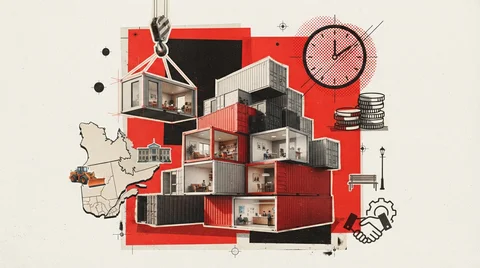
In short — Chaudière-Appalaches holds one of the SHQ's first 11 highly prefabricated housing projects: the SILA project in Lévis, announced August 22, 2025 with 48 units and delivery targeted for summer 2026 — while the 2026-2036 Quebec infrastructure plan mentions 72 units in planning at the same site, a gap still to be clarified. In a region where the labour shortage has employers demanding predictable measures, housing has become a competitiveness issue, and prefab an official answer.
The housing situation in the region
In Chaudière-Appalaches, the housing crisis expresses itself first through the economy. The region has one of the most acute labour shortages in Quebec, and its employers — united behind a common appeal reported by Mon Thetford in April 2026 — are demanding "more predictable and better adapted" measures on immigration and housing. The message is plain: without a roof for workers, no growth for the Beauce's factories or the Côte-du-Sud's businesses.
The private market, for its part, is hesitating. In Thetford Mines, a private real estate megaproject of more than 500 units announced in May 2025 has since been called into question and scaled back, according to the Courrier Frontenac — a reminder that large conventional builds remain fragile outside the major centres.
For the region's towns of 5,000 to 25,000 residents — think Sainte-Marie, Montmagny, Beauceville or Saint-Apollinaire — the structural challenge is the same as everywhere in regional Quebec: conventional developers rarely travel there for projects of 20 or 30 units. We explain that mechanism in our feature on the housing crisis and modular construction.
Recent projects and announcements
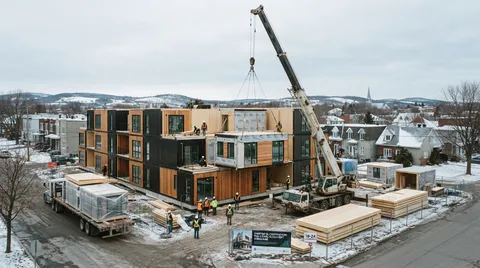
The regional flagship project is in Lévis. On August 22, 2025, the SHQ announced the 11 winners of its first call for highly prefabricated multi-unit housing — 336 units in total, entrusted to five design-build consortiums backed by Quebec factories (Bonneville, RCM Modulaire, Fabrik, Locusi, RG Solution). Among them: the SILA project in Lévis, 48 units, with delivery targeted as early as summer 2026.
An honest clarification is needed here: the 2026-2036 Quebec infrastructure plan mentions "72 residential units at Immeubles SILA, Lévis" in planning, according to Ma Beauce's review. Is it an additional phase or an enhancement of the initial project? Public sources have not settled it yet — so we stick with the 48 units of the official release, while flagging the gap.
The provincial demonstration is advancing in parallel: in Montreal, Projet Acadie — 26 modular units from the same program — was installed in under 12 months, permits included, according to the government release of June 2026. A second call for 225 units was launched in September 2025, bringing the total selected to 566 prefabricated units by mid-2026.
What modular can change here
The Lévis SILA proves the region knows how to win these calls — but the most interesting potential is in the mid-sized towns. Sainte-Marie, Montmagny, Beauceville or Saint-Apollinaire are exactly in the range where the SHQ's standardized format (24 or 36 units, 2 to 3 storeys) changes the game: enough need to fill the building, not enough volume to attract a conventional 100-door build. The mechanics of a factory-built multi-unit building are detailed in our feature on the modular multiplex.
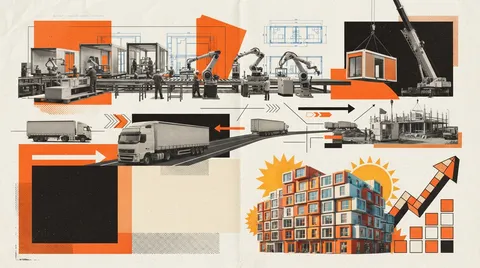
The time argument is especially strong here. The independent data converges: project timelines cut by 20 to 50% according to McKinsey, deliveries 25 to 30% faster measured across more than 50 multi-family buildings by a field study funded by the U.S. Department of Energy. And in a region where every construction worker is already claimed by factories and private job sites, shifting most of the work to a production line answers precisely the labour shortage employers are denouncing. Housing the workers themselves — the number one issue for Beauce manufacturers — is the subject of our guide to workforce housing in the regions.
Let's stay clear-eyed on costs: direct savings range from 0 to 20% depending on market and scale. The reliable gain is the schedule and its predictability — two words the region's employers use themselves.
The programs that apply
- SHQ initiative for highly prefabricated multi-unit housing: the region already has a winner (SILA, Lévis). The next calls rest on the $1.8-billion Canada-Quebec agreement (FACL).
- PHAQ (Programme d'habitation abordable Québec): the SHQ's flagship program, open to non-profits, co-operatives, housing offices and private developers. The 2026-2027 Quebec budget funds a new round of 1,000 affordable units — the first since 2023.
- CMHC — mortgage loan insurance extended to modular (May 2026): after a pilot of more than 800 units, modular multi-unit housing is insurable across all CMHC products, including APH Select.
- Maisons Canada: the federal agency with $13 billion explicitly prioritizes prefabricated, modular and mass-timber construction.
To structure a non-profit or co-operative financing package, see our guide to funding affordable modular housing; developers and municipalities will find their path in the developers' guide and the guide for municipalities.
Sources: Gouvernement du Québec (SHQ), Ma Beauce, Courrier Frontenac, Mon Thetford, CMHC. Article written by Jeremy Soares. Last updated: July 2, 2026.

8Module
Modular multi-residential buildings (6 to 24+ units) factory-built in Quebec.
Visit websiteCommercial partnership — we receive compensation. Disclosure
Frequently asked questions
Does the Lévis SILA project have 48 or 72 units?
Why does modular suit the towns of the Beauce and the Côte-du-Sud?
Which programs can fund an affordable housing project in the region?
Sources
- Construire autrement et plus rapidement : la voie du hautement préfabriqué est maintenant tracée — Gouvernement du Québec
- Budget 2026-27 : les projets de Chaudière-Appalaches au Plan québécois des infrastructures — Ma Beauce
- Un projet immobilier d'envergure remis en question à Thetford Mines — Courrier Frontenac
- Pénurie de main-d'œuvre : Chaudière-Appalaches lance un appel à des mesures plus prévisibles et mieux adaptées — Mon Thetford
- CMHC expands mortgage insurance support for prefab and modular construction — SCHL





Comments
A question or comment on this article? The comments section will be enabled soon.