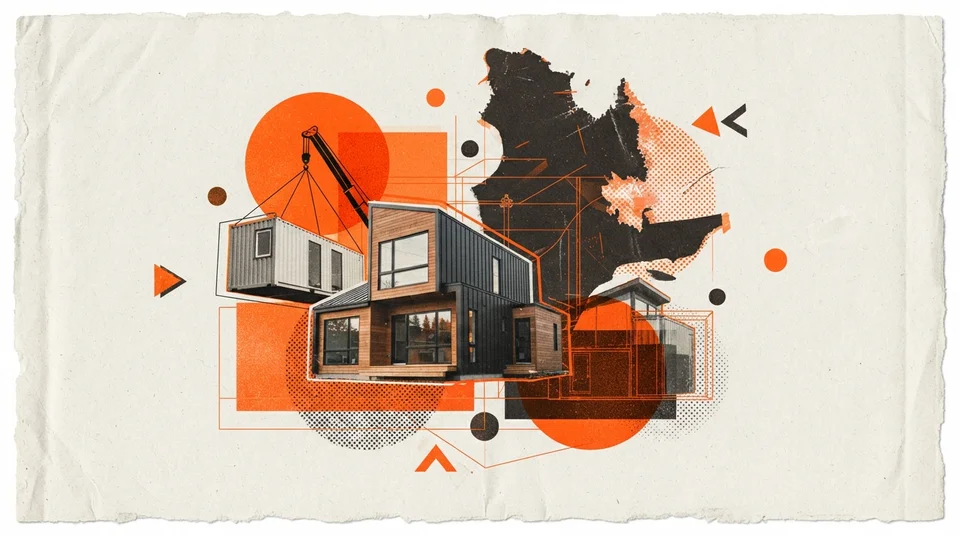
Residential · 10 min
Tiny Homes and Modular ADUs in Quebec: The Guide
In short — A tiny home is a dwelling with a small floor area (often under 50 m²); an ADU — accessory dwelling unit — is a second dwelling created on the lot of an existing house. Both lend themselves remarkably well to modular construction: built in a factory, delivered nearly finished, they install fast and cost less to implement than a traditional addition. The real obstacle is not the fabrication — it is municipal zoning, which decides whether you have the right to install one.
Interest in small dwellings is exploding in Quebec, driven by three realities: the cost of housing, an aging population that wants to stay close to family, and municipalities loosening their rules to densify "gently." Modular construction is the natural tool of this trend — but before ordering anything, you need to understand the vocabulary and, above all, check what your town allows.
Tiny home, ADU, multigenerational home: the distinctions
These terms get mixed up in everyday speech. Here is how to tell them apart.
| Term | What it is | Typical status |
|---|---|---|
| Tiny home | Principal dwelling with a small floor area (often < 50 m²) | Subject to zoning; a minimum floor area is sometimes required |
| ADU (accessory dwelling unit) | Self-contained second dwelling on the lot of an existing house (yard, basement, above the garage) | Allowed by some municipalities, under conditions |
| Multigenerational home | Secondary dwelling integrated into or attached to the main residence, for a relative | Often governed by a specific bylaw |
| Garden suite | Detached ADU, in the backyard | Detached — stricter zoning |
The key nuance: a tiny home is generally a principal dwelling, while an ADU is an accessory dwelling added to an already-built property. If the modular vocabulary itself (volumetric, factory-built, prefab) is not clear, start with our definition of modular construction.
Why modular is ideal for small dwellings
The smaller the building, the more the "site work" share weighs on cost and schedule. That is exactly where the factory takes the advantage:
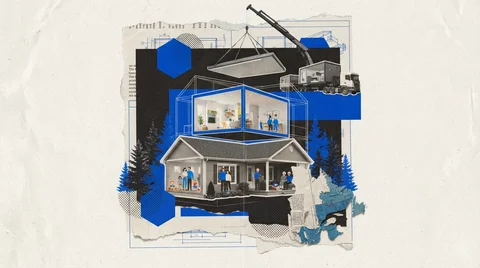
- Delivered nearly finished. A tiny home or ADU can be built as a single module, delivered almost turnkey and set in place in a day.
- Minimal site work. On a lot already occupied by a house, reducing on-site work limits the disruption, the mud and the duration.
- Quality and airtightness. On a small envelope, airtightness and insulation count double for comfort and heating — see our reference points for heating a small dwelling in Quebec.
What a modular ADU is for
The uses that most often motivate a project:
- Multigenerational housing — welcoming an aging parent while preserving their independence.
- Supplementary rental income — rent that helps pay the main residence's mortgage.
- Aging in place — moving into the small unit and renting out (or lending) the big house.
- A livable office or workshop — a separate space, but connected and heated year-round.
How much it costs
A tiny home or ADU costs less in total than a full house, but often more per square foot: the expensive elements (kitchen, bathroom, hookups) are concentrated on a small area. On top of the module's cost always come the off-factory items — foundation or piles, hookups (water/sewer or well/septic), transport and permits.
For up-to-date ranges and the logic of "factory price vs total project cost," use our price calculator and our guide to modular home prices.
Permits and zoning: the step that decides everything
This is the heart of the matter. An ADU is not automatically allowed: each municipality decides, through its zoning bylaw, whether it permits a second dwelling, under what conditions (maximum floor area, parking, hookups, appearance) and in which zones. Several Quebec towns have loosened their rules in recent years to encourage "gentle density," but conditions vary enormously from one municipality to the next.
The procedure is therefore always the same:
- Check your municipality's zoning bylaw — permitted uses, ADU allowed or not, conditions.
- Confirm the Construction Code (RBQ) standards that apply to the second dwelling.
- File a permit application before any installation.
Our guide to the building permit in Quebec details the process, and each city page shows where to find the local bylaw. Before anything else, make sure the lot is suitable: see land or home first.
Choosing your manufacturer well
Not every factory builds small units, and not every factory delivers everywhere. Compare builders on their experience with tiny homes and ADUs, their delivery zone and what their price really includes. Our reference points for choosing a builder apply in full.

8Module
Modular multi-residential buildings (6 to 24+ units) factory-built in Quebec.
Visit websiteCommercial partnership — we receive compensation. Disclosure
Frequently asked questions
What is the difference between a tiny home and an ADU?
Am I allowed to install an ADU on my lot in Quebec?
Is a modular tiny home cheaper than a standard house?
Can you finance a tiny home or an ADU?
Sources
- Habitation — logement accessoire et densité douce — Ministère des Affaires municipales et de l'Habitation (MAMH)
- Code de construction du Québec — Régie du bâtiment du Québec (RBQ)
- Mini-maisons et habitations de petite taille — Écohabitation


Comments
A question or comment on this article? The comments section will be enabled soon.