Multi-residential · 9 min
Modular Seniors' Residences (RPA) in Quebec
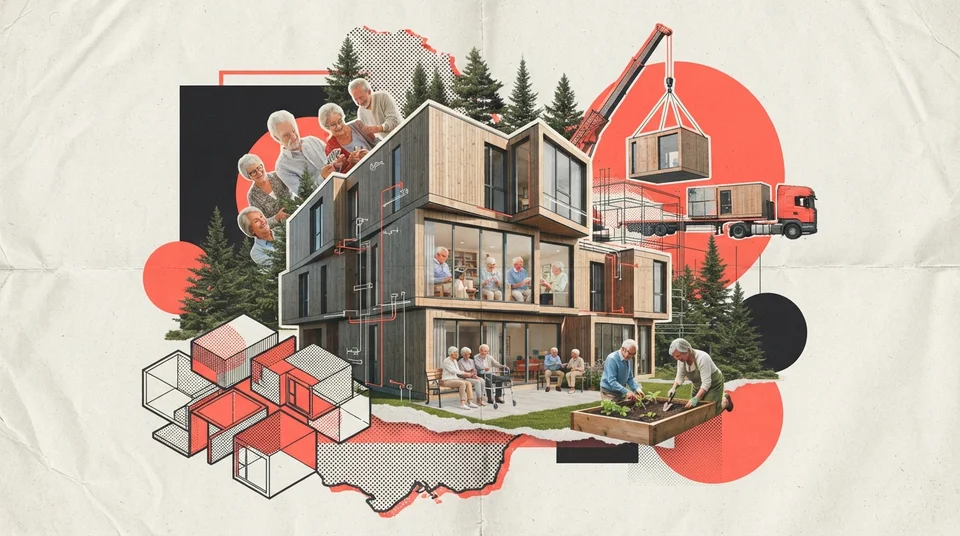
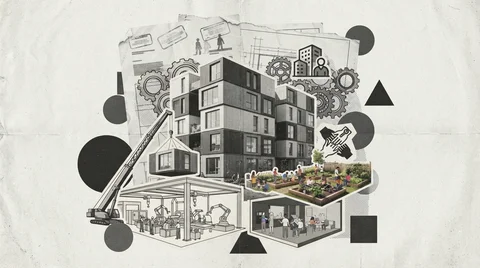
In short — A modular RPA (résidence privée pour aînés — Quebec's certified seniors' residence category) is a building for elderly residents whose modules are manufactured in a factory then assembled on site. In Quebec, the modular approach is particularly relevant here: it allows care spaces to be delivered faster, at a controlled cost, where the need is most acute — often in the regions.
Quebec's aging population is generating sustained demand for seniors' residence spaces, and that demand is dispersed: it exists as much in small towns as in large centres. That is precisely the profile of need where modular construction is most useful — and where content and informed thinking remain scarce.
Why modular fits RPA development
- Time. Every month without open spaces means a growing waitlist and deferred rental income. Factory production, running in parallel with site work, advances the opening date.
- Repetition. An RPA is essentially the same unit — an adapted dwelling — repeated. That is the factory's ideal use case: standardization, production cadence, quality control.
- Regional deployment. Building a small residence in a remote municipality is more predictable with modular construction, where most of the work happens in the factory rather than on a site subject to local weather and labour conditions.
For the financial logic from a developer's standpoint, see modular rental building: ROI and the commercial and multi-family pillar.
What an RPA requires beyond the standard
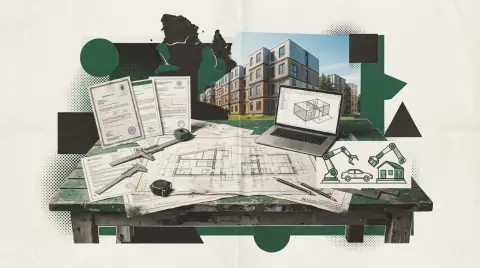
A seniors' residence is not an ordinary rental building. Beyond the Construction Code, it carries its own requirements: universal accessibility, enhanced fire safety, call and monitoring systems, common spaces and services. Above all, RPA operations are certified by the Quebec government — a framework entirely separate from construction alone.
| Dimension | What it entails |
|---|---|
| Construction | Quebec Construction Code + accessibility and fire requirements |
| Factory production | CSA A277 certification |
| Operations | RPA certification (government framework / MSSS) |
| Services | Common spaces, meals, monitoring per category |
Note — Modular changes the construction method of an RPA, not its operating obligations. RPA certification remains a distinct process that must be anticipated very early.
For the construction framework, see modular construction and the RBQ; for certifications and programs, see certifications, associations and funding.
Costs, financing and programs
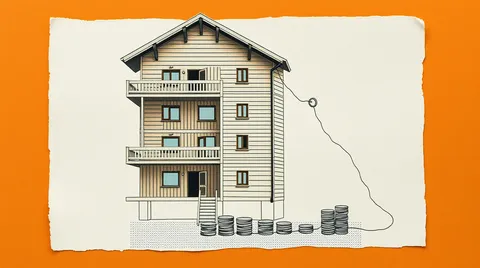
Total cost combines, as with any modular project, the factory-finished building, the land and site work, the foundation, connections and transport. An RPA's financing can draw on housing programs (provincial via the SHQ, federal via CMHC), whose criteria and funding envelopes change — to be validated case by case. For projects with an affordable or community purpose, see also modular affordable housing and our resources page.
The central economic argument remains the schedule: opening spaces sooner generates income sooner and reduces the carrying cost of land and financing during construction.
Small regional residences: the winning angle
Where modular construction shines in particular is the small neighbourhood RPA — a few dozen spaces in a municipality that has none. The program is repetitive, the need is local and concrete, and the speed of deployment directly addresses the gap. It is an underserved niche, well aligned with the demographic reality of Quebec's regions. In Quebec, manufacturers specializing in multi-unit housing such as 8Module offer the repetitive configurations of 6 to 24 units that match this small regional residence profile.
Disclosure — 8Module is a commercial client of Modulaire Québec; we receive compensation when we refer a lead. This content remains editorial and independent — 8Module neither commissioned nor reviewed it. Full disclosure.
Sources: Régie du bâtiment du Québec (Construction Code), Gouvernement du Québec / MSSS (RPA certification), Société d'habitation du Québec (programs). Guide written by Jeremy Soares. Last updated: June 25, 2026. Certification requirements, timelines and funding must be validated with the official bodies before making any decision.

8Module
Modular multi-residential buildings (6 to 24+ units) factory-built in Quebec.
Visit websiteCommercial partnership — we receive compensation. Disclosure
Frequently asked questions
Is a modular RPA subject to the same requirements as a traditional RPA?
Does modular make it possible to open a residence faster?
Are there programs to finance an RPA?
Is modular well suited to small regional residences?
Sources
- Code de construction du Québec — Régie du bâtiment du Québec (RBQ)
- Certification des résidences privées pour aînés — Gouvernement du Québec / MSSS
- Programmes d'habitation — Société d'habitation du Québec (SHQ)
Comments
A question or comment on this article? The comments section will be enabled soon.