Residential · 6 min
A House Frame in Five Hours: What Bécancour's Automated Factory Really Changes
In short — In Bécancour, Groupe Fournelle's new automated plant assembles the complete structure of a single-family home in about five hours. Automated saw and hammer, wood waste cut from 20% to under 3%, output that can double without hiring: Quebec framing just changed scale. Here is what that concretely changes — and what it does not.
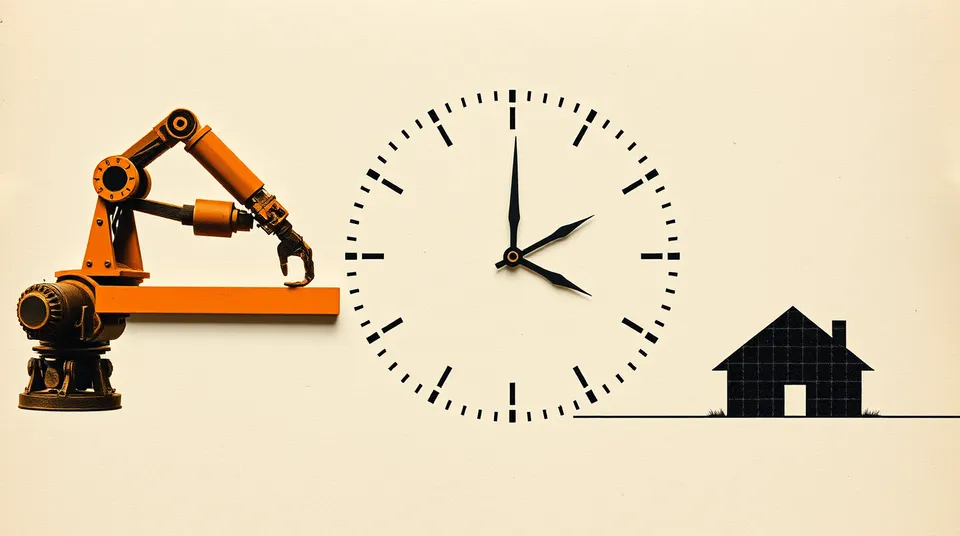
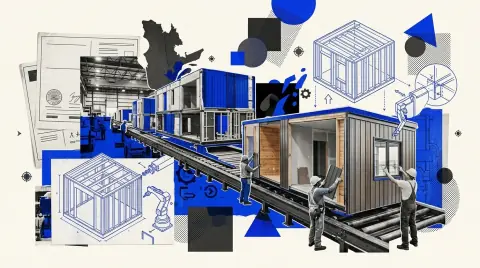
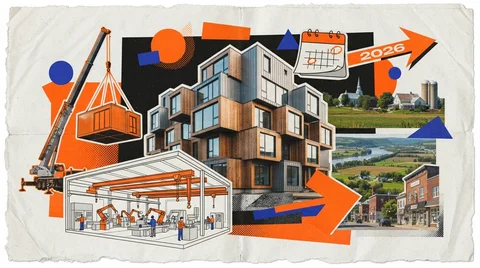
Picture the scene to grasp what it means: programmed tools that know what to cut and where to nail, wall and floor panels moving from station to station, and at the end of the line the entire structure of a single-family home ready for the road — all in about five hours, Radio-Canada reported in June. That is what now comes out of Groupe Fournelle's new plant in Bécancour, an investment of about $7 million.
Five hours for a frame is not a carnival stunt. It is a symptom of what happens when construction moves from the lot to the factory — the underlying argument we lay out in we build cars in factories, why not homes?
What automation changes: waste and consistency
Two figures from that report deserve a pause.
First, wood waste. Around 20% in conventional building, according to the company; under 3% on the automated line. When the saw is programmed, every offcut was planned before it existed. At the scale of one house, that is lumber; at the scale of a full order book, it is a margin.
Second, capacity. Company president Jérémie Fournelle told Radio-Canada that production could double, even triple, with roughly the same number of employees. In an industry where the labour shortage is the permanent bottleneck — documented in our piece on real modular project timelines — a factory that produces more without hiring more is exactly the lever Quebec is looking for.
And demand is there: despite the residential construction slowdown, the plant's order book remains full, according to the same report. Its first public client is already under way — a CPE daycare built by prefabrication near Bécancour's new elementary school.
Where this factory came from
The project is not new. As early as June 2024, Radio-Canada reported that Groupe Fournelle was launching a prefab-structure plant in Bécancour: over $7 million invested, a $2.8 million loan from Quebec, some twenty jobs created and roughly four times the capacity of its facilities at the time. Local context weighed heavily: the municipality, bracing for the battery-sector boom, then estimated its needs at 6,700 housing units over ten years.
That is the landscape we describe in our state of play on modular housing in Centre-du-Québec: an industrial region drawing workers faster than it builds roofs, where prefabrication stops being a curiosity and becomes infrastructure.
What the five hours do not say
Let us be precise, because the shortcut would be easy: nobody moves in five hours after the first hammer strike.
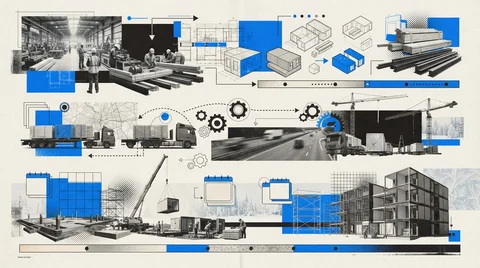
Fournelle builds prefabricated structures — wall panels, floor elements — that are then assembled on the foundation. That is panelized prefabrication, a cousin of volumetric modular construction but distinct from it; the process families are untangled in what is modular construction? Before those five hours you need a lot, a poured foundation, connections; after them remain the building envelope, mechanical, electrical, plumbing and finishes.
In other words: the factory compresses the framing, not the full calendar — and even less the total budget, in which the frame is one line item beside land, foundation, transport and finishes. To see how those items actually add up, our modular home price guide and our calculator give the order of magnitude, item by item.
What the five hours really say is something else: the part of the work that can be industrialized is being industrialized, here in Quebec, with measurable effects on waste, consistency and capacity. Every time a link in the chain moves into the factory, the site gets shorter and the risk gets smaller.
Shopping for a factory-built home and wondering what it would cost, delivered and set on your lot? We can prepare a quote request with builders active in your region.

8Module
Modular multi-residential buildings (6 to 24+ units) factory-built in Quebec.
Visit websiteCommercial partnership — we receive compensation. Disclosure
Frequently asked questions
Can you really build a house in five hours?
What does automation change about the price of a prefab home?
Is panelized prefabrication the same thing as modular construction?
Why is this factory in Bécancour?
Can I buy a home from this factory?
Sources
- Une maison préfabriquée à Bécancour, montée en cinq heures — Radio-Canada Info
- Une usine de fabrication de maisons préfabriquées à Bécancour — Radio-Canada Info
Comments
A question or comment on this article? The comments section will be enabled soon.